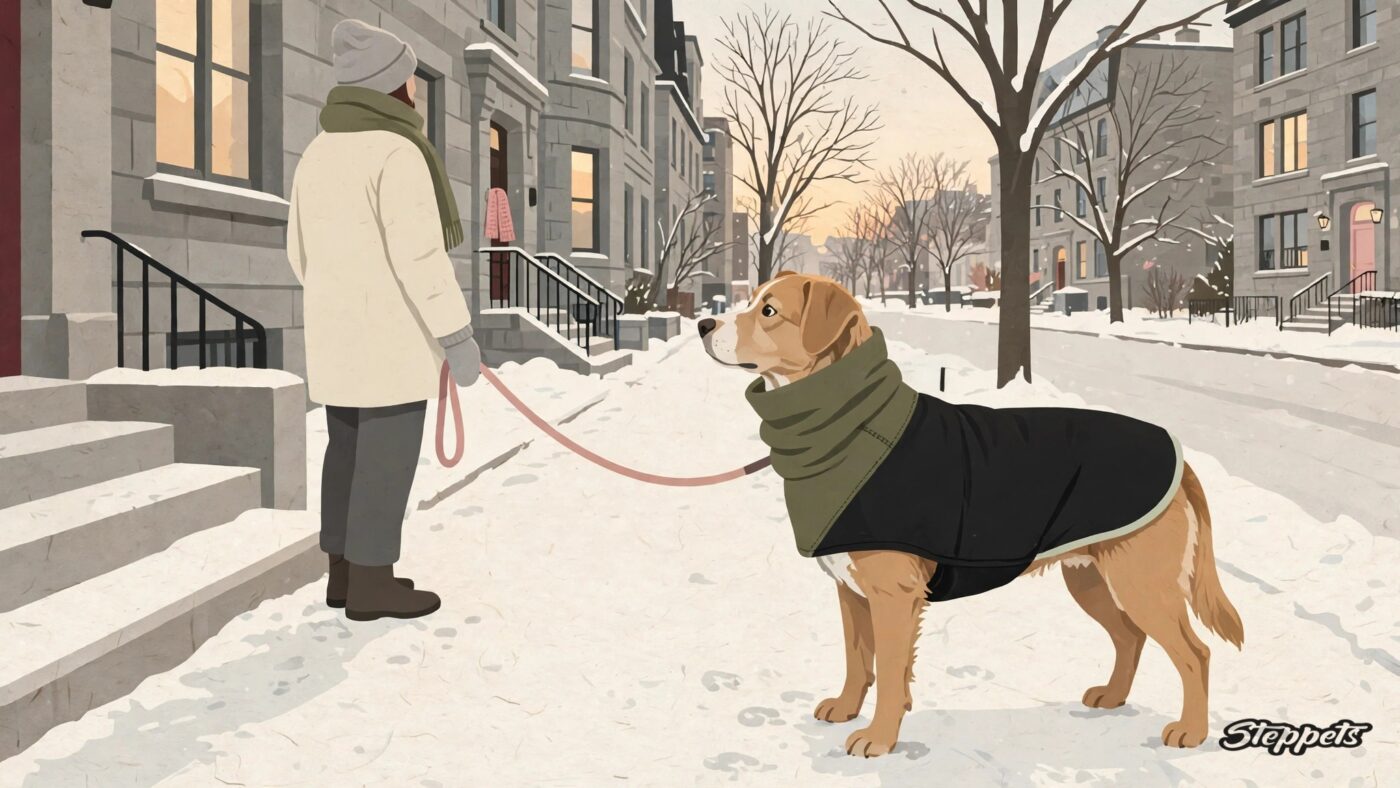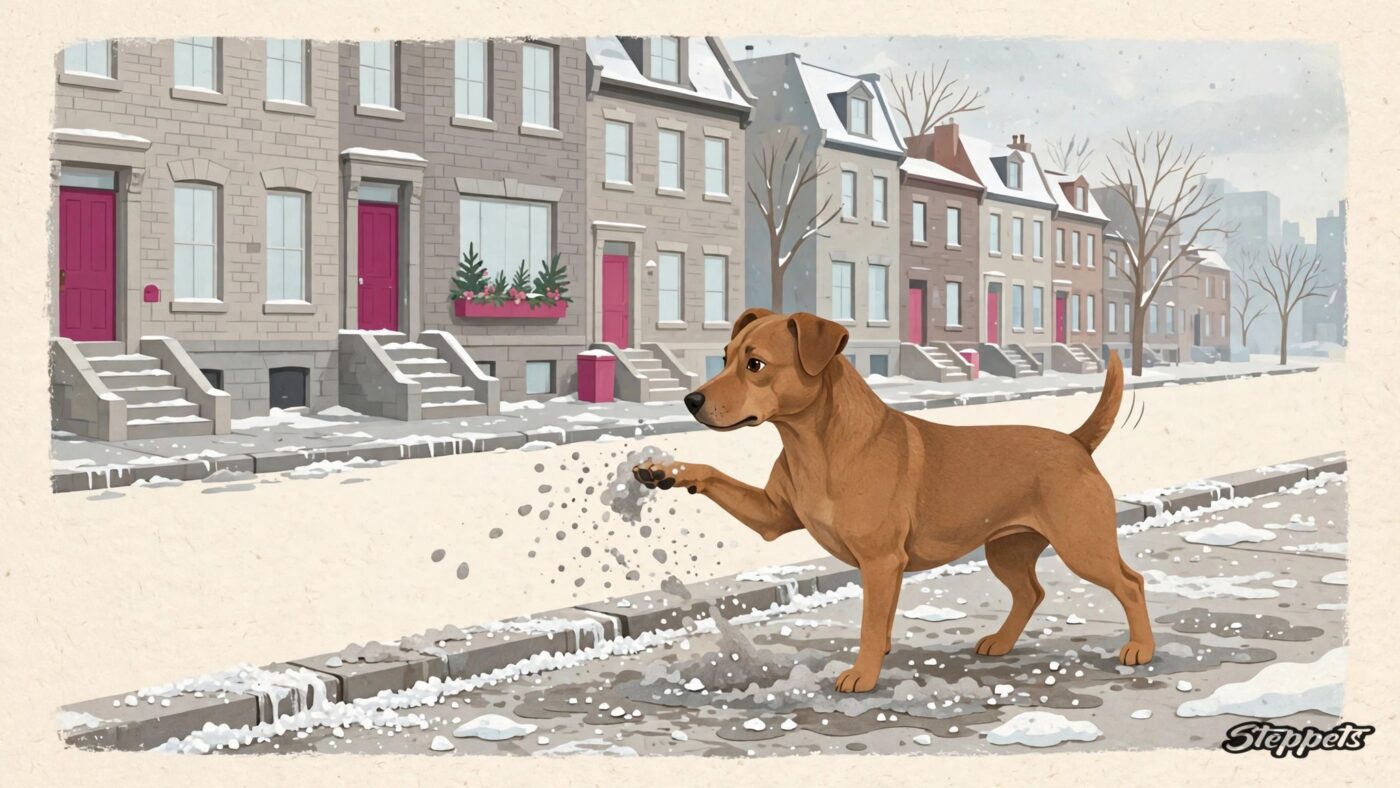
By the second week of November, Montreal’s sidewalks change underfoot. The city spreads salt before the snow has even landed, the intersections turn to grey slush, and every crosswalk has a puddle of brine pooled at the curb. Your dog walks through all of it barefoot. Cold is the hazard people ask about, but salt is the one doing quiet, daily damage on ordinary walks — so this guide is about exactly that: how to protect dog paws from salt in winter, from the first salty morning to the last slush puddle of March.
A note on links: Some links in this post are affiliate links. As an Amazon Associate I earn from qualifying purchases — buy through one of these links and we receive a small commission, at no extra cost to you. It’s one of the ways this blog pays for itself. We only link to products we would genuinely recommend, and only to things we don’t sell ourselves.
What’s actually on the sidewalk
“Road salt” is really three products, and they don’t treat paws the same way. Rock salt — ordinary sodium chloride — is the workhorse: cheap, spread everywhere, effective down to about −10°C. On paws it’s a drying agent; it pulls moisture out of the pads and leaves them rough. Calcium chloride, the white pellets you see on steps and building entrances, works in deeper cold and is noticeably harsher on skin — it generates a little heat as it dissolves, which is good for melting ice and miserable inside a cracked pad. Magnesium chloride, used in some blends, is generally the gentlest of the three, but “gentlest” is relative: it’s still a chemical meant to be rinsed off, not worn all evening.
Then there’s brine — liquid salt sprayed on roads and sidewalks before a storm. It’s nearly invisible, it coats everything, and dogs walk through it on days when the pavement looks dry. Add the sand and grit spread for traction, which packs between toes and grinds against already-sore pads, and a Montreal sidewalk in January is a genuinely hostile surface for bare feet. You also can’t control what each homeowner and shopkeeper puts down on their stretch — which is why route choice matters: packed-snow park paths and quiet side streets are far easier on paws than arterial sidewalks, and the worst of it concentrates at intersections, exactly where you have to stand and wait for the light.
What salt does to paws
Healthy pads are tough, slightly grippy, and a little supple. Salt attacks the supple part first. A week of salted walks dries the pads out; dry pads crack; and salt worked into a fresh crack stings every step. Your dog’s response is the second half of the problem: he licks. Licking removes the salt, but it also roughens the pad further and swallows de-icing chemicals that can upset his stomach — which is why the classic winter pattern is sore feet plus a queasy dog, from the same walk.
The signs to watch for are specific. Redness or irritation between the toes. Licking or chewing at the feet after walks, beyond a quick tidy-up. Limping or mincing on salted pavement but walking normally on clean snow — that contrast is the tell. Pads that look dry, flaky, or cracked. In worse cases, raw spots or blistering: that’s a chemical burn, not just dryness.
Most of this is managed with the routine below, and this page is general care information, not medical advice. But some of it isn’t routine: cracks that bleed, sores or blisters, limping that doesn’t resolve once you’re indoors, or vomiting or diarrhea after a heavy licking session. If you see any of those, skip the home remedies and call your veterinarian — pads are slow to heal on a dog who has to walk on them, and earlier is better.
Ice balls: the quiet second problem
Salt isn’t the only thing winter puts between a dog’s toes. Snow collects in the fur between the pads, body heat melts it slightly, and it refreezes into hard little marbles of ice. An ice ball changes how the foot lands, spreads the toes, and makes dogs limp mid-walk — then walk perfectly again the moment it’s removed, which is how you know what it was.
Dogs with longer fur between the pads are the most prone, but any dog can collect them in the right snow. Prevention is mostly grooming: keep the fur between the toes trimmed flush with the pads (blunt-tipped scissors, or ask your groomer to add it to the regular trim), and a layer of paw balm before the walk helps snow release instead of packing. On the walk, if the limp appears, stop and clear the toes with a warm bare hand — never yank an ice ball out, since the fur frozen into it comes too. At home, the rinse below melts whatever’s left.
Before the walk: the barrier
The first line of defence goes on before you leave. A wax-based balm (affiliate link), worked into the pads and between the toes in a layer you can actually see, keeps salt from sitting directly on the skin and gives packed snow less to grip. Look for a pet-grade paw balm with lick-safe ingredients — your dog will lick some of it off no matter what you do, so the ingredient list is the product — and one that stays put in the cold rather than going brittle at −15°C. Apply it at the door, not twenty minutes early on the rug, and reapply on long walks; one application is a wearing barrier, not a coating.
For many dogs and many routes, balm plus the rinse afterwards is the whole system. If your walks are short, your streets are lightly salted, or your dog travels mostly on packed snow, you may never need more than this.
Boots: when a barrier isn’t enough
Boots earn their keep where balm runs out: heavy-salt routes, pads that are already cracked and healing, and determined lickers who remove a barrier layer before you’re off your own street. A physical barrier doesn’t care how salty the intersection is. The honest trade-offs: most dogs hate boots at first — expect the hallway high-step and the betrayed stare — and cheap boots fall off in slush, which is worse than no boots, because now you’re carrying a wet dog *and* searching a snowbank.
Two things decide whether boots work. The first is acclimation: a few minutes indoors with treats, then a short outing, building up over days — not a first fitting at the door in a storm. The second is fit, and fit is where sizes lie. Measure your dog’s paw with his weight on it, in centimetres, and match the maker’s chart rather than his usual “medium.” It’s the same discipline as measuring for anything a dog wears — our guide to how to measure a dog for a coat is about coats, but the principle transfers exactly: measure, don’t guess. Within boots, choose a double-strap closure that stays on in slush and a treaded sole with real grip for ice (affiliate link) rather than a smooth fashion sole. And if your dog gives boots a genuine trial and still votes no — some do — then balm, route choice, and shorter salt exposure is a legitimate system, not a failure.
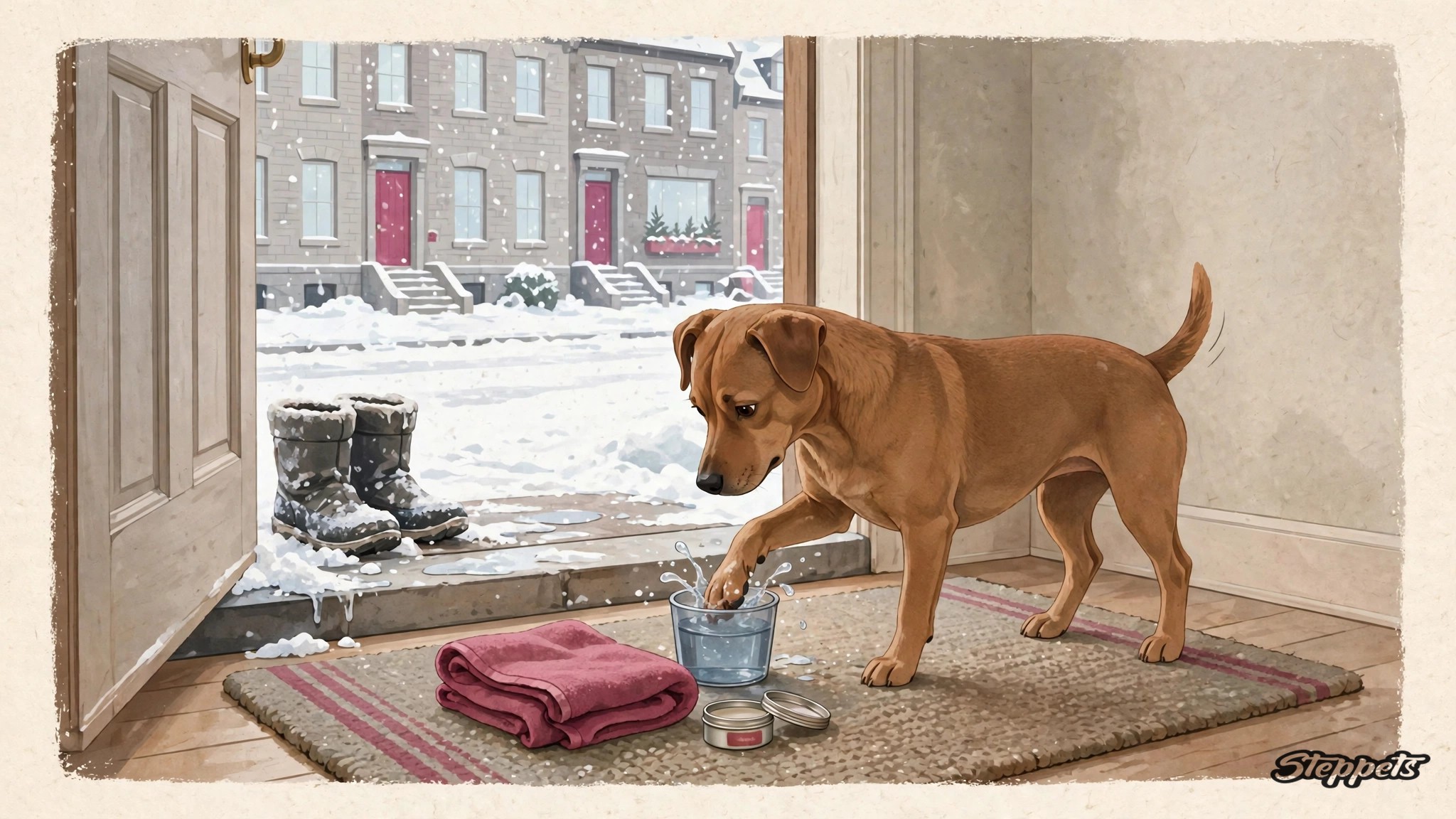
Back home: the two-minute door routine
Whatever protection went on, salt has to come *off* at home, because what stays on the pads keeps drying them and keeps getting licked. The routine is deliberately small so it survives February: rinse all four paws in lukewarm water — never hot — paying attention to between the toes, where salt and grit sit. A paw washer cup (affiliate link) kept by the door turns this into a thirty-second dip per foot instead of a sink production, and the good ones have soft silicone bristles and come apart for cleaning. A basin of water and a towel costs nothing and works nearly as well; the habit matters more than the tool.
While you’re there, check between the toes for ice balls and stuck grit, then dry thoroughly — damp feet invite more licking. On cracked pads, a little balm *after* the rinse is the soothing half of the routine. Low-riding dogs get one extra step: a quick wipe of the belly and legs, which catch the brine spray off the sidewalk. That’s it. Two minutes, every walk, all winter — the routine does more than any single product.
The winter paw checklist
Before you leave:
- Balm worked into the pads and between the toes — or boots on, for heavy-salt routes and healing pads
- Route chosen with paws in mind: packed snow and side streets over arterial sidewalks where you can
- Toe fur trimmed short if your dog collects ice balls
On the walk:
- Cross intersections briskly; don’t stand in the brine puddle at the curb
- A sudden limp usually means an ice ball — stop, clear the toes with a warm hand, walk on
- Limping on salt but fine on snow is information: that route needs boots or a different street
Back home:
- Rinse all four paws in lukewarm water; check between the toes; dry properly
- Balm on cracked pads after the rinse
- Watch the licking: feet that get chewed at all evening are feet that need a vet’s eyes, not more balm
Salt, in the end, is a solvable problem — a barrier before, a rinse after, and boots for the worst streets will carry most Montreal dogs through the whole season. It’s worth keeping separate from the other winter question, though: on the coldest days, the limit isn’t salt but the air itself, and our guide to how cold is too cold for a dog works through the temperature bands for those mornings. And the paw routine only ever covers the ground floor of the dog. The rest of him — chest, back, neck — is what a coat built for cold Quebec winters is for; it just won’t do anything for bare pads on a salted sidewalk. Paws are their own system. Now it’s a system you have.