Do Basenjis get cold? Yes — quickly, and honestly. A Basenji is a thin-coated African breed with a short, fine, single coat and very little body fat, built for a climate where winter never arrives. Put that dog in a Montreal winter and there is no mystery about what happens: she feels the cold sooner than almost any dog on the street, she tells you about it plainly, and she needs a coat, a routine, and an owner who reads her signals instead of assuming she will tough it out. This is the Canadian-winter Basenji guide, written from the dog it was built around — Luna, our own female tri-colour Basenji, the dog the Steppets workshop exists because of.
The short answer: yes, and sooner than you think
A Basenji’s coat is the first thing to understand, because it does almost none of the work a northern breed’s coat does. There is no dense undercoat trapping warm air against the skin, no long guard hairs shedding snow, and very little body fat underneath to burn for heat. What a Basenji has is a short, fine, single layer — elegant, easy to keep clean, and about as insulating as a light sweater. In dry, calm cold she can manage for a while, especially moving. Add wind, and the thin layer gives up its warmth fast. Add wet — rain, slush, wet snow — and the cold reaches her skin almost immediately, because there is nothing to hold it off.
The second thing is temperament, and it cuts both ways. Basenjis are famously self-possessed dogs: clean, quiet, independent, not given to fussing. That independence means a Basenji will not always complain the way a more vocal dog would. She may simply slow down, hunch, tuck her tail, and start steering for home — or, on the worst days, plant herself at the door and decline the whole expedition. Owners who read that as stubbornness miss the point. It is the same refusal our guide to dogs who refuse winter walks works through: a dog telling you something physical about the walk, in the only language she has.
So the working rule for a Basenji in Canada is simple: treat her as one of the most cold-sensitive dogs you will meet, and read the temperature bands in our Quebec winter guide one step colder for her. Around −7 °C is already the caution zone for a lean, single-coated dog — shorter walks, a layer on, closer attention to paws. Below roughly −12 °C, most dogs do better with protection and a purpose, and a Basenji is firmly in that group. At −20 °C and below, the honest answer for almost every dog is minutes, not walks — and for a Basenji, that means a short, protected outing for the toilet and then back inside. Those bands are general care guidance, not a rating for any garment, and your own dog’s behaviour on the day outranks any number on a forecast.
Luna, the living case study
Luna is not a stock photo of a Basenji. She is a real dog living through real Montreal winters, and she is the reason the Griffin coat exists — the first Steppets coat was sewn for her, because nothing off the rack fitted her and nothing off the rack kept her warm. Her five measurements, published on our Fitting Room page, are the numbers the coat was drafted from:
- Neck circumference: 33 cm
- Neck length: 13 cm
- Chest circumference: 56 cm
- Front chest width: 16 cm
- Back length: 38 cm
Read those numbers together and you can see the Basenji shape in figures: a slim neck and a fine frame carrying a chest that is deep for the dog’s size, on a back that is short beside it. That combination is exactly what ready-made sizing handles badly. A coat sized by chest alone swamps the neck; a coat sized by back length leaves the chest short; a coat sized by weight guesses at all of it. Luna’s numbers are also why the measuring guide matters more for this breed than for most — the full method is in our guide to measuring a dog for a coat, worked through on Luna herself, and the same five numbers are what the Griffin is drafted from.
What Luna does on a cold morning is the best cold-tolerance test any owner has, and it costs nothing to run. On a dry, calm morning she trots out happily, ears up, sniffing everything. On a wet, windy morning she slows at the curb, hunches her back, and looks for the door. She shivers at temperatures a Husky would consider a pleasant spring day — and she is right to. Shivering is the body spending energy to stay warm, and a dog who is shivering on the walk is a dog whose walk is already too long for the conditions. If the shivering will not stop once she is back inside and dry, or it comes with lethargy, confusion, or ears and paws that feel cold and look pale, that is no longer a winter problem — get her inside, warm her gently, and call your veterinarian rather than trying to manage it yourself.
What a Basenji actually needs in winter
The needs are few, but they are not optional. A Basenji in a Canadian winter needs a coat, a paw routine, and a shorter, sharper walk — in that order.
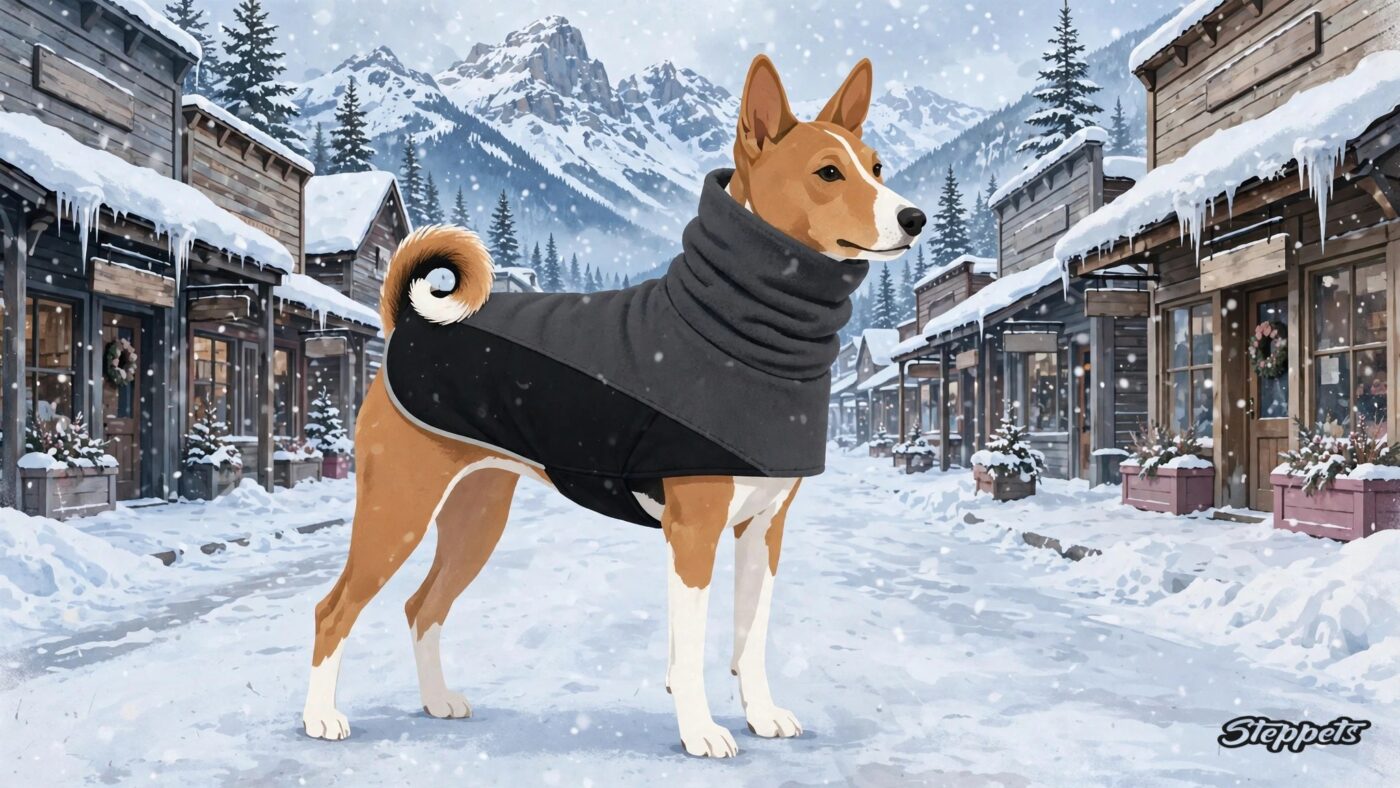
A coat that covers the neck and chest. The two places a Basenji loses heat fastest are the neck and the deep chest, and those are the two places most off-the-rack coats leave open or cover badly. A coat for a Basenji needs a neck section that actually travels up the neck and sits smoothly when the head is up, down, or turned — not a loose ring that drops and gaps, and not a tight collar that stops her lowering her head to sniff. It needs chest coverage that follows the sternum down and back, instead of stopping at a straight line and leaving the deepest part of the ribcage exposed. And it needs to stay put: a strap placed behind the chest’s widest point, where the body gives it something to hold, rather than on the rising tuck where it migrates with every step. The fit failures are the same ones our sighthound fit guide catalogues — Basenjis are not sighthounds, but the geometry that breaks generic coats is close kin: deep chest, slim neck, fine frame, very little margin for a pattern that guessed.
The test is dynamic, and it takes five minutes. Put the coat on, walk, trot a few steps, turn both ways, let the dog lower her head and shake. The strap should stay where it started, the neck should neither strangle nor fall open, and the coat should move with the shoulder instead of arguing with it. If the dog’s stride shortens the moment the coat goes on, the coat is the problem — take it off and see whether the reluctance disappears on the next outing. A coat that binds is worse than no coat on a short walk, because it makes the dog hate the walk itself.
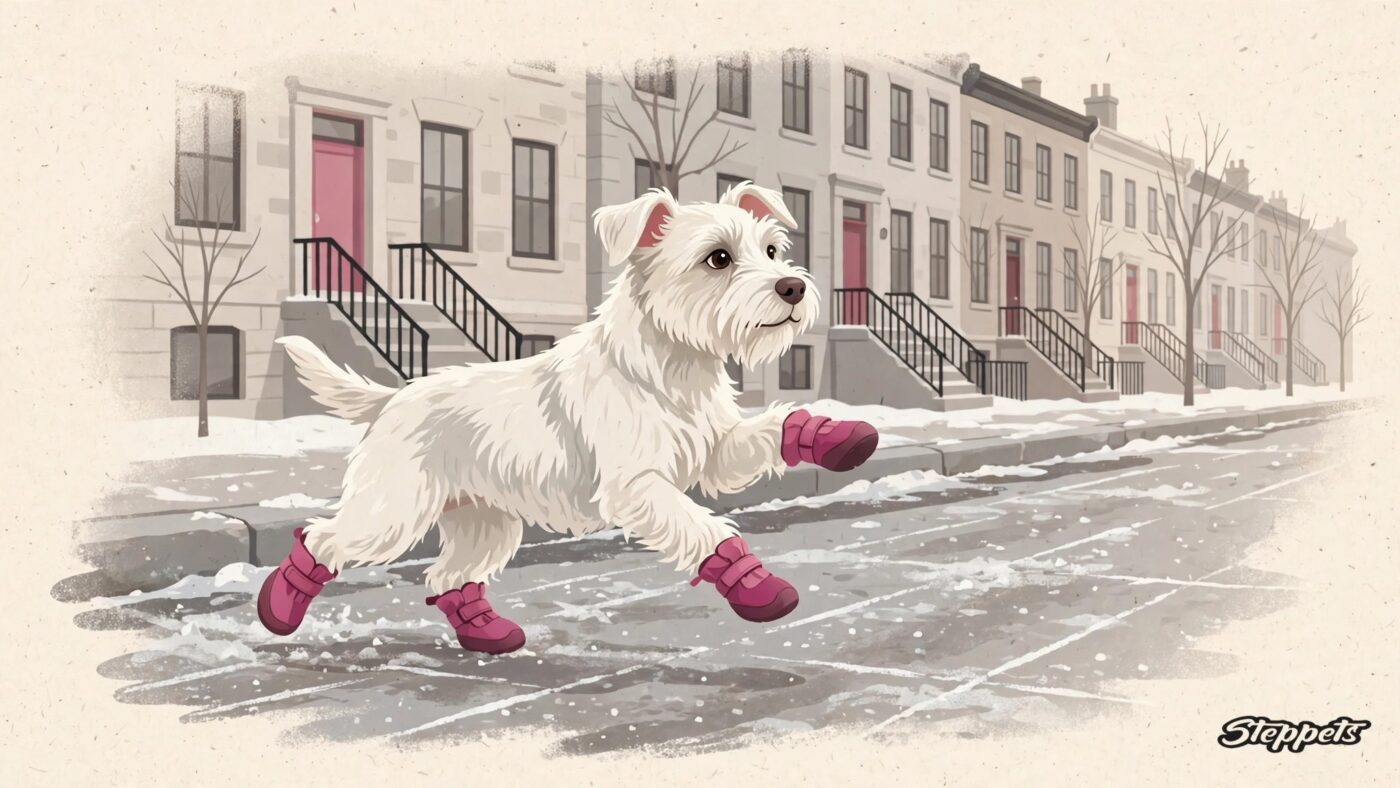
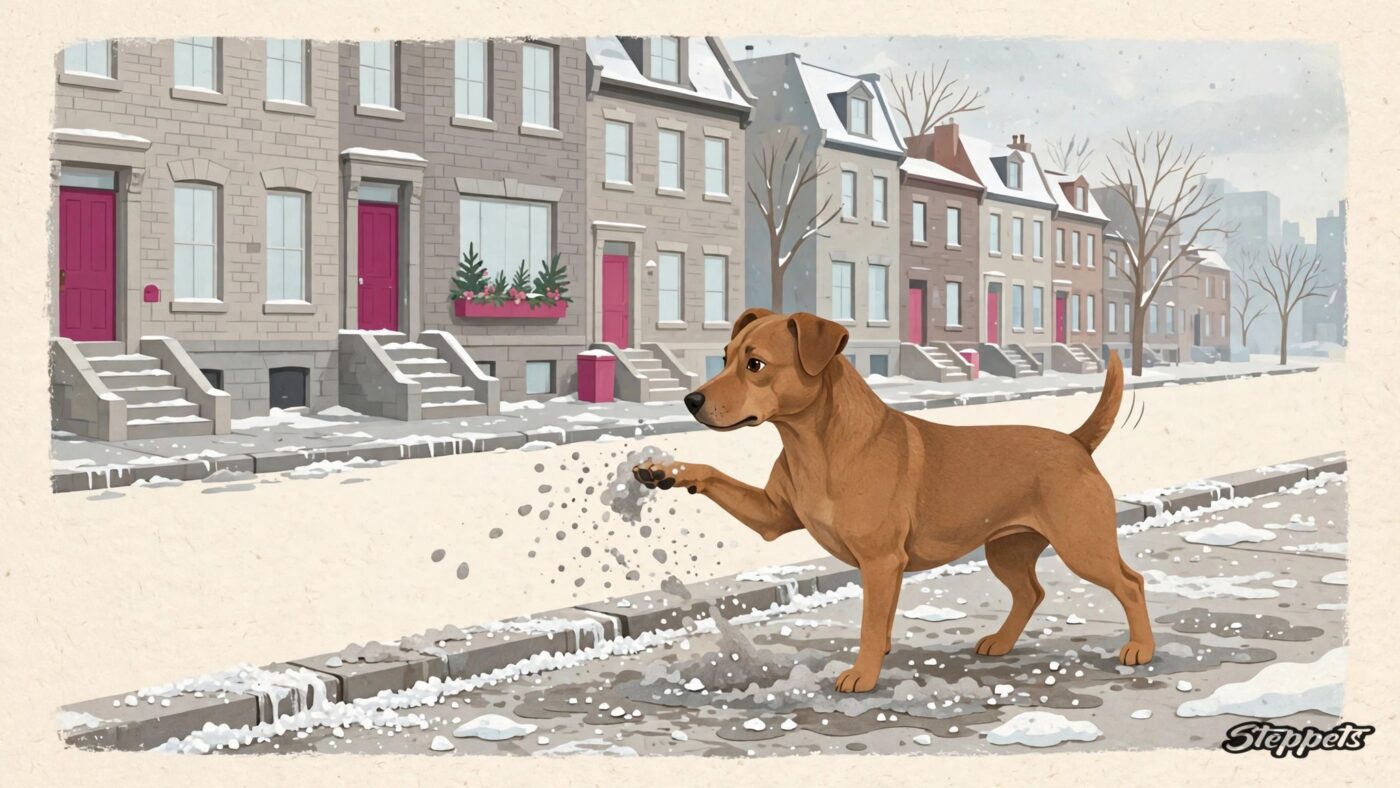
A paw routine at the door. Basenji paws are as unprotected as the rest of her: bare feet on salted sidewalks, brine pooling at every curb, snow packing between the toes and refreezing into hard lumps. The routine is the one in our road salt and winter paws guide — lift each paw at the door before and after the walk, look between the toes, rinse the salt off every time, and use a paw balm barrier or boots on the worst salt days. A Basenji who stops, lifts paws, or tries to walk on the snow at the edge instead of the sidewalk is telling you about her feet, not her attitude.
Shorter walks, more of them. The Basenji winter walk is a different shape from the summer one: out, business done, a brisk loop, home — and then indoor work to spend the energy. Puzzle feeders, training games, and play inside replace the long ramble on the days the weather says no. A Basenji who has learned that wet walks end in shivering will start refusing at the door before you have felt the rain yourself, and she is not wrong. Keep the first walks of the season short while pads toughen up, and keep the worst wet-windy days to toilet breaks. You can always go out again later; you cannot undo a chilled dog.
The winter routine that works for Luna
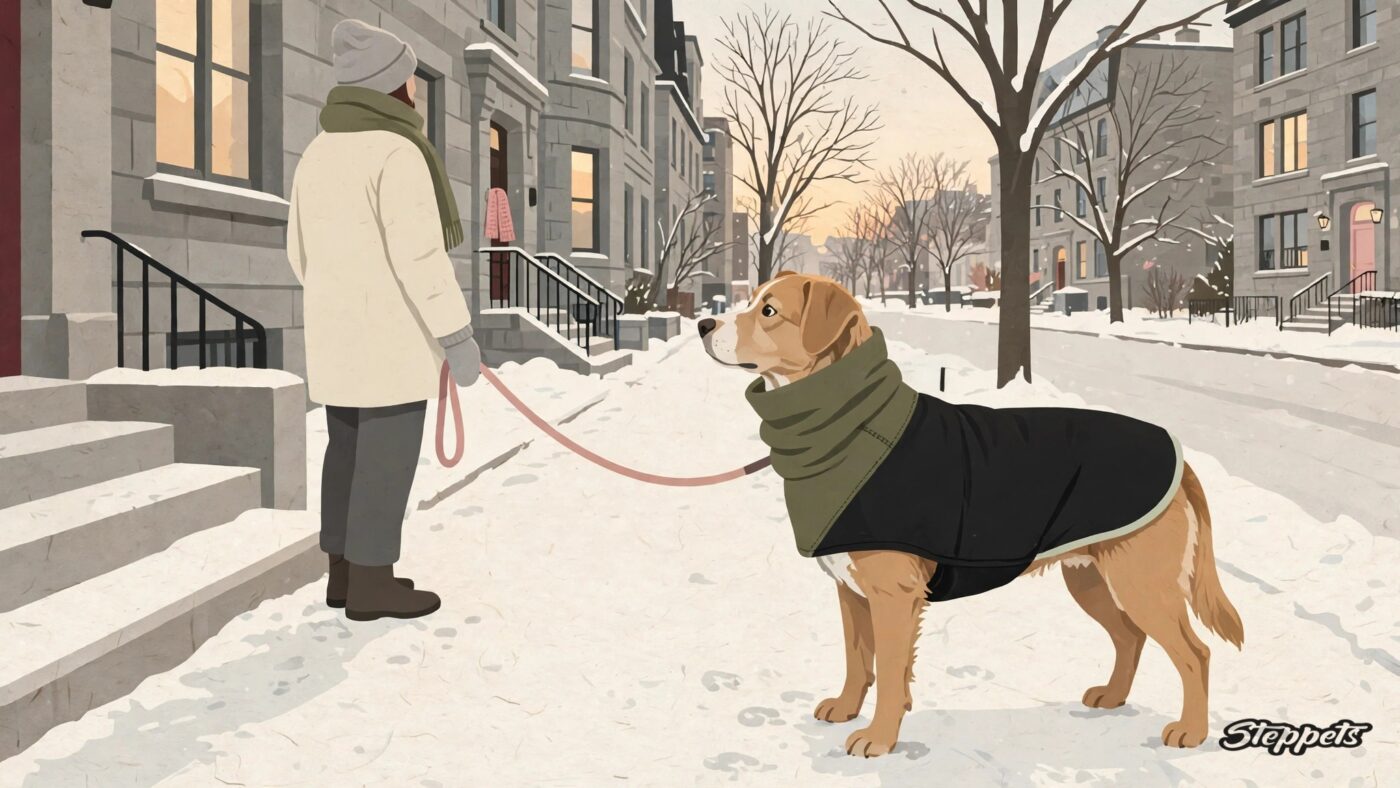
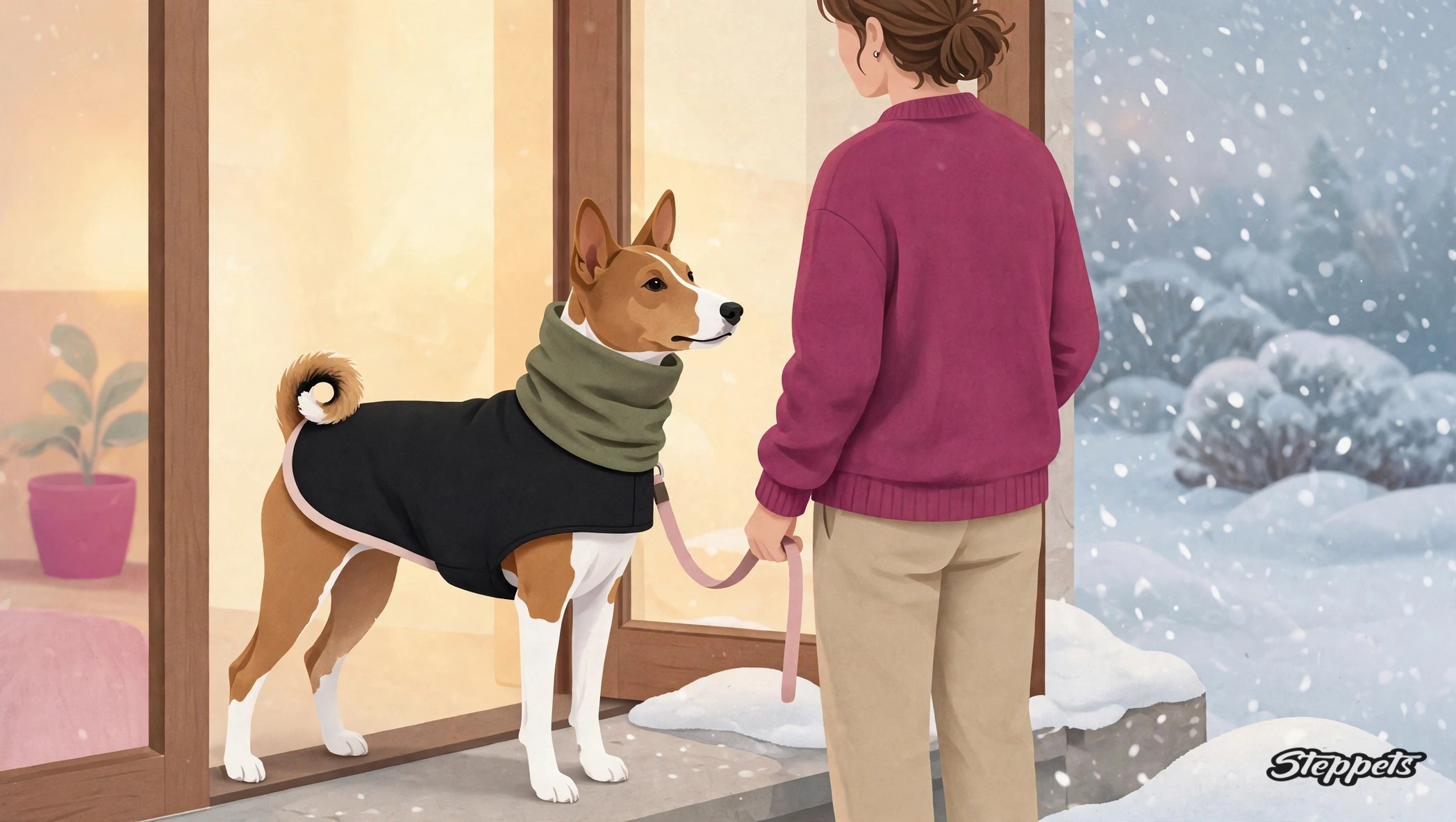
On an ordinary cold morning, the routine runs like this. Coat on at the door — neck section settled, strap checked, a quick look from the side to confirm the chest is covered and nothing is twisted. Out the door and onto the packed snow at the edge of the sidewalk where there is a choice, rather than the salted middle. A brisk loop, not a dawdle: standing around at an intersection in wind is where a thin-coated dog loses heat fastest, so the walk keeps moving. Home, coat off, paws lifted and rinsed, chest and belly dried properly — especially on wet days, when drying at the door matters more than the walk itself. Then inside, warm and dry, for the play that the walk did not provide.
On a wet day, the routine shrinks: rain at 2 °C chills a Basenji faster than dry cold at −10 °C, because wet fur loses the insulation dry fur provides and evaporation keeps cooling her after she is back inside. A short outing and a proper dry at the door matter more than any layer. On the coldest days, below −20 °C, the routine is a toilet break and nothing else, however much the dog seems to want more.
Indoors, a Basenji in winter needs what every dog needs and one thing more: a warm place to curl up that is actually warm. Basenjis seek heat — a sunny patch, a blanket, a lap — and a dog who spends the evening pressed against the radiator or burrowed under a blanket is not being dramatic. She is managing her own temperature the only way she can. Give her the blanket. A snood or a light indoor layer on the coldest evenings is a legitimate choice for a dog with this little insulation, not an indulgence.
Basenjis and snow: the honest picture
Basenjis do not hate snow in the abstract. Many of them love a first snowfall — the novelty, the smells, the clean ground — for about ten minutes. What they hate is being cold and wet in it, and the two arrive together fast on a thin-coated dog. Deep snow is a particular problem: a Basenji’s belly is low enough that fresh snow brushes it with every step, and wet belly fur chills the core. A cleared path, a packed trail, or a loop where the snow is trodden down is a kinder walk than a plunge through fresh powder, however photogenic the powder looks.
They also hate the dark, in the specific way winter dogs do. By mid-November in Montreal the sun sets before half past four, and most winter walks happen in the dark. Snow covers the scent map of the whole neighbourhood, and for a dog who navigates largely by scent, the evening walk is a different world every night. A Basenji who balks at the threshold on a dark evening is often being cautious, not defiant — the same short, familiar loop, at the same time, until it is boring, works better than long exploratory walks in the dark.
One more Basenji trait matters in winter, and owners discover it at the worst moment: the breed is famously quiet, and famously clean. A Basenji will not always bark her discomfort, and she will groom herself meticulously after a walk — including licking salt off her own paws. That is why the rinse at the door is not optional for this breed. Salt left on the pads keeps drying them, keeps getting licked, and turns a small irritation into cracked pads over a week of walks. Rinse first, then let her groom.
Buying a coat for a Basenji: what to check
If you buy off the rack, check the coat on the dog, not on the hanger — and check it in motion. Strap position first: put it on, walk, and see whether the strap sits behind the chest’s widest point or slides onto the tuck. Chest coverage in profile: look from the side, and confirm the deepest part of the ribcage is covered rather than left as the lowest exposed point. Neck behaviour: the dog should lower her head to sniff without the neck opening digging in or falling away. Leg clearance: check behind the forelegs after several minutes of movement, not just standing — early pinkness or displaced hair is a warning. And the twist test: after a turn and a shake, is the centre back still the centre back?
Size-chart honesty matters more here than for most breeds. If the brand gives only weight, or only back length, expect guesswork. A Basenji needs chest and neck numbers in the decision, and the relationship between the numbers is the story: Luna’s slim 33 cm neck beside a 56 cm chest on a 38 cm back is exactly the combination a single size label cannot express. That is the case for measuring rather than guessing, and for a coat drafted from the dog’s own measurements — the Griffin is made to measure from those five numbers, in wool with a fleece neck section, built for cold Quebec winters — rather than a coat graded from a generic block and hoped for. You can see the coat and start from your dog’s measurements on the Griffin custom dog coat page. We will not promise you a temperature number for it; no honest coat maker can. What a well-fitted coat does is move your dog one band in the right direction, and on a −12 °C evening, that is the difference between a bathroom break and a real walk.
Frequently asked questions
Do Basenjis get cold easily?
Yes. A short, fine, single coat and very little body fat mean a Basenji feels cold sooner than most breeds, and sooner than owners who grew up with double-coated dogs expect. Treat her as one of the most cold-sensitive dogs you will meet, and read the temperature bands one step colder for her.
How cold is too cold for a Basenji?
As general care guidance, around −7 °C is already the caution zone for a lean, single-coated dog — shorter walks and a layer on. Below roughly −12 °C, keep it to a short, protected outing. At −20 °C and below, minutes, not walks. Wind and wet move every dog up a risk band, and a Basenji most of all. Watch the individual dog: shivering, hunching, lifting paws, and steering for home are the real limits, whatever the forecast says.
Do Basenjis need a coat in winter?
In a Canadian winter, yes — a Basenji needs a coat for anything beyond a quick toilet break once the temperature drops into single digits below freezing, and sooner with wind or wet. The coat needs to cover the neck and the deep chest, stay in place while she moves, and let her shoulders move freely. A coat that binds or twists is worse than a short walk without one.
Can a Basenji live in Canada?
Yes — Luna does, through every Montreal winter. A Basenji can live very happily in Canada with a coat, a paw routine, shorter winter walks, indoor play to spend the energy, and a warm place to curl up at home. The breed is not fragile; it is thin-coated. The adjustment is routine, not heroics.
Why does my Basenji refuse to walk in winter?
Usually for a physical reason: cold paws, salt sting, a coat that binds, wind and wet, or early darkness. Work through the causes in order, from the ground up — paws first, then coat fit, then the weather itself — before assuming stubbornness. A dog who walked fine last week and now refuses everything, or who limps, yelps, or seems lethargic, should see a veterinarian before the next walk.
Do Basenjis like snow?
Many enjoy a first snowfall for a few minutes, and many dislike being cold and wet in it soon after. Deep, wet snow is the hardest combination for a low, thin-coated dog. Packed trails and cleared paths, short outings, and a proper dry at the door make snow season workable — and a warm blanket at home makes it worth it.