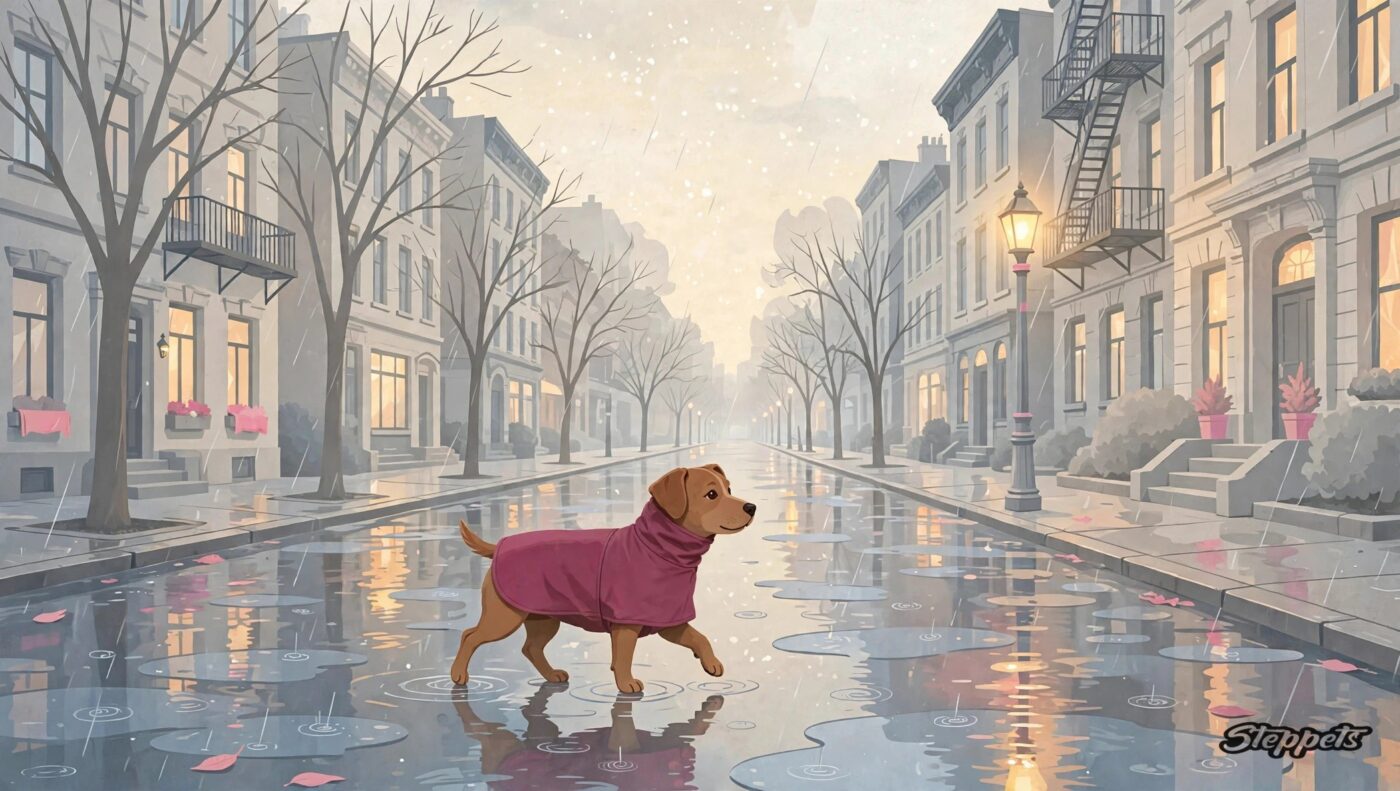
November in Montreal has a particular kind of cold that fools people. The thermometer says 2 °C — practically mild after a Quebec winter — and yet the dog comes home from a twenty-minute walk shivering, hunched, and miserable, in a way she never did on a dry −10 °C morning in January. The owner standing at the door, towel in hand, ends up asking the question this whole post is about: is a dog rain coat in cold weather actually worth it, or is a wet dog just a wet dog?
It is worth it, and the reason is not obvious from the thermometer. Two degrees and rain chills a dog faster than ten below and dry, and once you understand why, the whole wet season — November now, March again in spring — gets easier to manage.
Why wet beats cold: the insulation is air, not fur
A dog’s coat keeps him warm the same way a down jacket keeps you warm: not by the material itself, but by the still air trapped inside it. Fur holds thousands of tiny pockets of air against the skin, and still air is a poor conductor of heat. Water ruins that arrangement twice over: it displaces the air, and water conducts heat away from the body far faster than air does. The insulation is not reduced a little; the thing doing the insulating is gone, replaced by the thing doing the conducting. Then the water leaves by evaporation, which draws still more heat out of the dog as it dries. A wet dog standing in wind is being cooled from the inside by conduction and from the outside by evaporation at the same time.
Wind is the multiplier. Our cold-weather guide already notes that a windy −8 °C can chill a dog faster than a calm −15 °C, because wind strips away the warmed air a coat traps. On a wet dog there is barely any warmed air left to strip — the wind goes straight to work on damp skin. That is the whole wet-cold problem in one sentence: rain takes the insulation, wind takes the heat, and evaporation keeps taking it after you are both back inside.
The 2 °C vs −10 °C comparison, honestly stated
Take the two walks side by side. At −10 °C, dry and calm, a healthy adult dog’s coat is doing its job: air trapped, heat held, the dog moving and generating warmth of his own. He may need a coat if he is small or short-coated, but the cold is at least honest about itself. You can see it, dress for it, and plan around it.
At 2 °C in steady rain, the same dog’s coat is saturated within minutes. The belly and chest — the parts that brush wet grass and catch the splash from every puddle — go first, and those are the parts over the core muscle mass where heat loss matters most. He is not generating enough warmth by walking to keep up with what the wet coat is conducting away, and if there is any wind, the gap widens. He comes home colder, in a real physiological sense, than he would have from a shorter walk at −10 °C dry. The practical consequence is a rule of thumb worth keeping for the whole shoulder season: judge a November walk by wetness and wind, not by the number on the thermometer. A dry 2 °C day is a normal walk. A wet and windy 2 °C day is a short walk, a rain layer if your dog has one, and a proper dry-off at the door.
Who gets cold first in the rain
The dogs who suffer most in wet cold are the same ones who suffer most in dry cold, only sooner:
- Small dogs — more surface area relative to body mass, so they lose heat faster, and their bellies ride close to the wet ground and the slush.
- Lean, short-coated breeds — sighthounds, Boxers, Dachshunds, Chihuahuas, and our own Luna, a Basenji with a short, fine, single coat and very little body fat. Rain reaches their skin almost immediately; there is no dense undercoat to hold it off.
- Puppies and seniors — both regulate temperature less efficiently, and seniors with arthritis feel the cold-and-damp combination in their joints as well as their core.
- Clipped or recently groomed dogs — a fresh clip removes much of the coat’s thermal protection, and owners often forget the dog they take home from the groomer is not the dog they dropped off.
Double-coated breeds — Huskies, German Shepherds, Goldens — have the best natural defence: water-resistant guard hairs over a dense undercoat that sheds moderate rain. Even they have a limit. In a real downpour the guard hairs are overwhelmed, water reaches the undercoat, and the same physics applies. “Built for snow” is not “built for standing in the rain.”
Signs your dog is too cold in the rain
The early signs are the same ones from our cold-weather guide, and they mean the same thing in November as in January — the walk is over:
- Shivering that does not settle once he is moving
- Lifting or favouring paws, or “dancing” on cold, wet ground
- Hunched posture with the tail tucked tight
- Slowing down, sitting, or refusing to go on, or pulling toward home and shelter
Wet cold adds one sign worth knowing separately: a dog who comes inside, gets dried, and is still shivering twenty minutes later has not caught up yet. Keep him warm and dry and watch him. The serious signs are different in kind, not just degree — intense shivering that suddenly stops while the dog is still cold, lethargy or confusion, ears and paws that feel cold and look pale or grey. Those can be signs of hypothermia, and this page is general information, not medical advice: if you see them, get your dog inside and call your veterinarian or an emergency veterinary clinic right away. One detail vets stress that owners get backwards: a cold dog who has stopped shivering is not necessarily warming up. It can mean the body has run out of the energy to shiver, and that is worse, not better.
Rain layer first, warm layer second
This is the decision that confuses owners most, because it feels backwards. On a wet 2 °C day, the layer that matters most is the one that keeps the water out — not the thickest, warmest layer you own. A heavy insulated coat with no water resistance soaks up rain like a sponge, and then you have a cold, wet weight held directly against the dog’s skin, doing the opposite of its job. The insulation underneath only works if it stays dry.
The order that actually works in wet cold is: a water-resistant outer layer first, warmth underneath it. A rain shell over a fleece or wool layer on the days that need both, and the shell alone on the milder wet days when the dog’s own coat plus movement is enough warmth — provided the shell keeps the rain off the chest and back. The shell does not need to be heavy; it needs to cover the core, stay put while the dog moves, and not trap humidity underneath. Take it off indoors. A dog left wearing a waterproof layer inside the house will sweat into it, and damp skin under a warm coat is the wet-cold problem all over again, indoors.
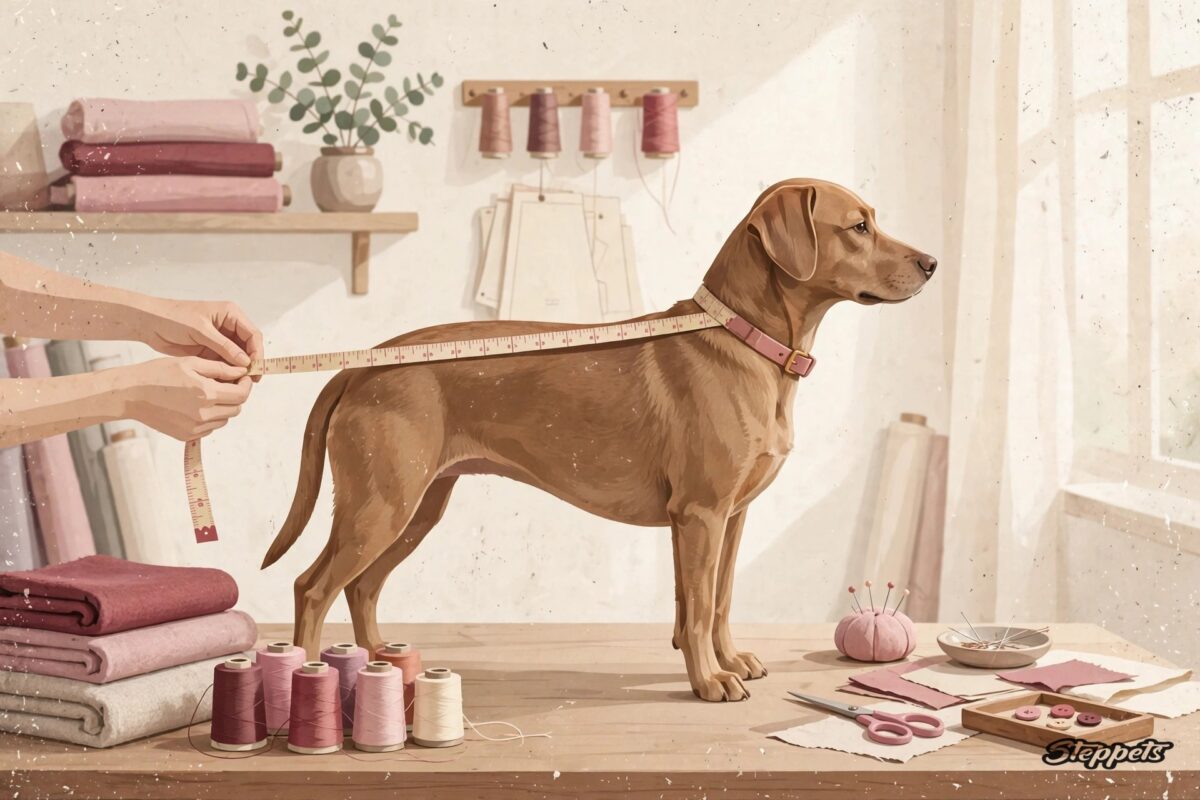
What we will not do here is promise a temperature number for any garment — no honest coat maker can, and the variables (dog, wind, wetness, time) are exactly the ones this post is about. What a well-fitted rain layer does is keep the insulation you already have — fur, fleece, wool — dry enough to work. The Griffin coat is built around the same thinking: a wool body for warmth with a separate fleece neck section covering the neck-and-chest junction a regular coat leaves open, made to measure from five measurements because “size medium” fits almost no dog properly. A rain shell over it is the layering system doing its job — warmth inside, weather outside.
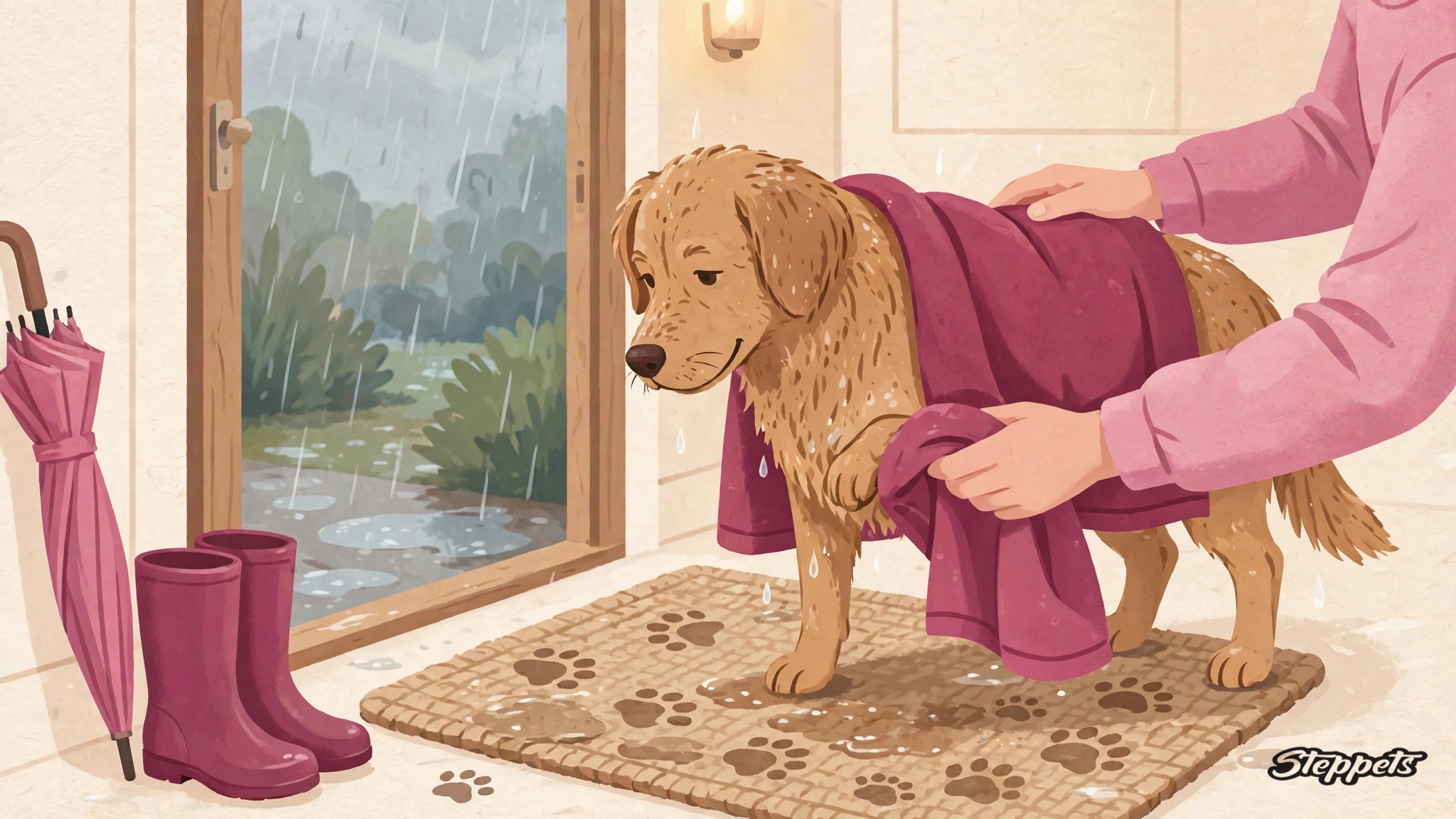
The drying routine: ten minutes that matter more than the walk
The most underrated part of wet-weather dog care happens at your own front door, and it takes about ten minutes. A dog who is dried properly after a wet walk recovers fast; a dog left to air-dry in a cool hallway keeps losing heat to evaporation for an hour.
- Towel first, before anything else. Rub the chest, belly, and ears — the places that got wettest and matter most — then the legs and paws. A second dry towel is worth having; the first one is soaked by the time you finish the belly.
- Paws get the full treatment. Rinse or wipe all four feet to remove road salt and grit, check between the toes for packed slush, and dry between the pads.
- Check the armpits and groin. Long-coated dogs mat here first when wet, and matted fur holds damp against the skin long after the rest of the coat feels dry.
- Warm room, dry bed, no draught. Let him warm up in a warm room before any big meal or bath, and do not put a wet dog in a cold crate or a draughty porch to “dry off.” If you use a dryer, keep it on low and moving — never hot, never held on one spot.
One more habit for the season: keep the towel by the door, not in the bathroom. The routine only happens every time if the towel is already where the wet dog is.
A November walking routine that respects the rain
November walks in Montreal need a different plan than January walks. The days are short — both the morning and evening walks happen in the dark by mid-month — the rain is frequent, and the temperature sits in the band where owners underestimate the cold. A routine that works:
- Shorter loops, more often. Two twenty-minute outings beat one forty-minute soak. The dog still gets his exercise and his sniffing; he just never gets saturated.
- Sheltered streets over open stretches. River corridors and open parks run colder and windier than built-up streets, and the wind is doing half the chilling on a wet day.
- Reflective gear after dark. A reflective collar or leash is how a driver sees your dog at a crosswalk at 5 p.m., and November rain makes visibility worse for everyone.
- Watch the paws on salted routes. The first salt goes down earlier than most owners expect — balm before the walk, rinse after.
- Know your dog’s wet limit. Luna tells us plainly: she slows, hunches, and looks for the door. Whatever your dog’s version is, learn it in November, because the same signal at −15 °C in January will mean the walk is already too long.
Frequently asked questions
Can a dog get hypothermia from rain?
Yes — hypothermia is about heat loss outrunning heat production, not about the thermometer reading. A dog soaked in cold rain, especially with wind, can lose heat fast enough to become dangerously cold even when the air temperature is above freezing. Small, lean, short-coated, young, old, or unwell dogs are most at risk. Shivering that will not stop, weakness, confusion, or shivering that stops while the dog is still cold are all reasons to get the dog inside, dry, and warm — and to call your veterinarian or an emergency clinic right away.
Do dogs need raincoats?
Not every dog, and not in every rain. A healthy double-coated dog in light drizzle usually does not. The dogs who genuinely benefit are the small, the lean, the short-coated, the young, the old, and any dog who will be out in steady rain for more than a few minutes. The test is the dog, not the forecast: if he comes home shivering and hunched from a wet walk, he needed the layer. A rain layer’s job is keeping the coat underneath dry, which is why it matters more than extra warmth on a wet day.
Is 2 °C and rain really worse than −10 °C and dry?
For most dogs, yes — or at least it chills them faster. Dry cold leaves the coat’s insulation intact; rain replaces the insulating air in the fur with water that conducts heat away, and then wind and evaporation keep removing heat. A short walk at −10 °C dry, with the dog moving and his coat doing its job, is often the easier day. The comparison is not a licence to ignore deep cold — at −10 °C and below, walks still get shorter and protection still matters — it is a warning not to be fooled by a mild-looking number on a wet day.
How do I dry my dog after a rainy walk?
Towel the chest, belly, ears, legs, and paws first, with a second dry towel if the first is soaked. Rinse paws to remove salt and grit, check between the toes, and check the armpits and groin on long-coated dogs. Then a warm room and a dry bed, away from draughts. Do not leave a wet dog in a cold hallway or crate to air-dry — evaporation keeps cooling him long after the walk is over.
Ready for your dog’s winter?
November is the month that teaches you your dog’s real limits — not the January limits, the wet ones. Learn them now, while the stakes are low: shorter loops, a rain layer when the day is wet and windy, and ten minutes with a towel at the door. If you want to get the fit right before the deep cold arrives, our Fitting Room walks you through taking the five measurements a made-to-measure coat needs, and it takes about two minutes with a soft tape. And if you want the full temperature picture, our guide to how cold is too cold for a dog covers the dry-cold bands this post builds on. Winter is long here. We might as well get it right together.