Most dog coats don’t fail because the coat is bad. They fail because the dog was measured like a suitcase — one number, usually weight or a guessed back length, then a hopeful choice between Small, Medium and Large. A dog is not a size; it’s a set of proportions — a neck, a chest, a back, and the distances between them. Learning how to measure a dog for a coat is the whole game: get it right and almost any coat fits better; get it wrong and even an expensive coat twists, gaps and rubs.
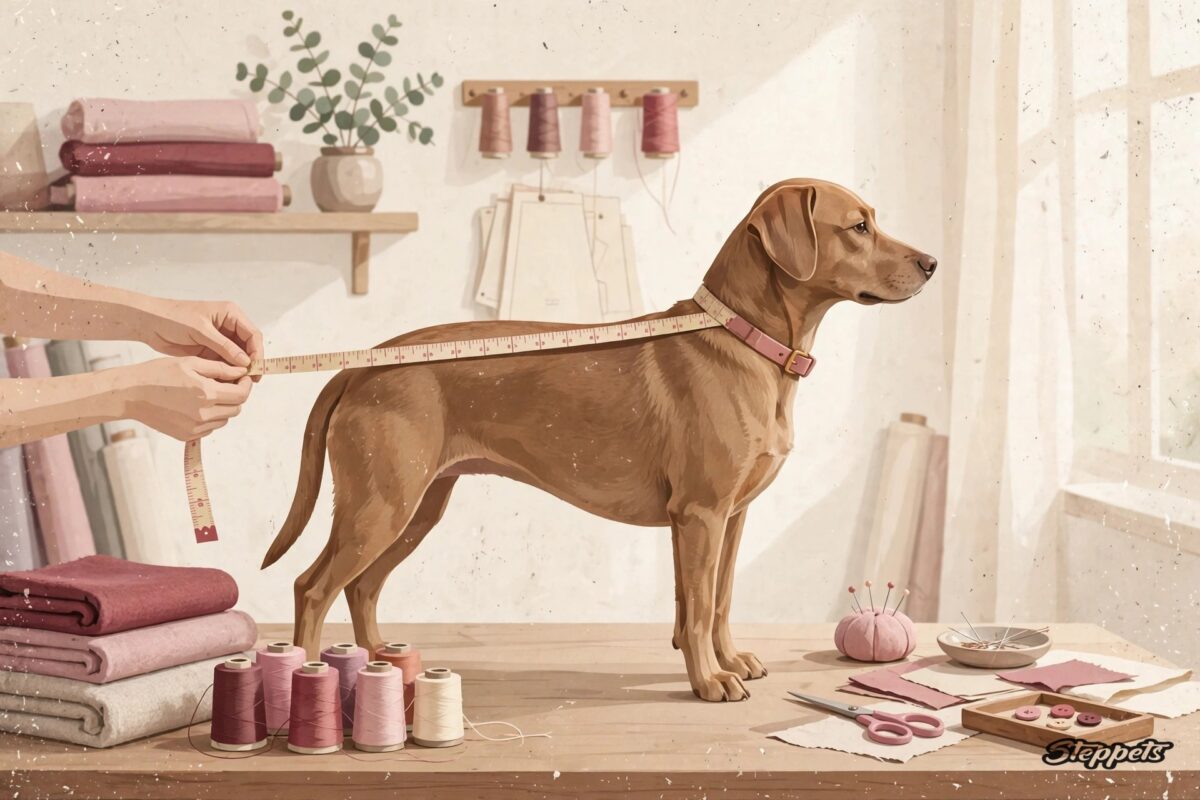
This guide teaches the five measurements we use at Steppets to draft a made-to-measure coat pattern: neck circumference, neck length, chest circumference, front chest width, and back length. They take about five quiet minutes with a soft tape, work for any breed or mix, and once written down they serve for any coat. Our worked example is Luna, our female Basenji — the dog the Steppets coat was first made for. Her real measurements, published on our Fitting Room page:
- Neck circumference: 33 cm
- Neck length: 13 cm
- Chest circumference: 56 cm
- Front chest width: 16 cm
- Back length: 38 cm
What measurements do you need for a dog coat?
Five: neck circumference, neck length, chest circumference, front chest width, and back length. Take them with a soft tape while the dog stands square on a hard floor — four feet planted, head up, weight even. On Luna, a female Basenji, those five measurements read 33, 13, 56, 16 and 38 cm.
Why Size Charts Fail (and Why Your Dog Is Not a “Medium”)
A size chart is an average pretending to be a fact. Somewhere, a manufacturer measured a handful of dogs — or more often, designed a coat, graded it up and down, and assigned letters:
- Breed variance is enormous. A French Bulldog and a Basenji can weigh much the same, but the Bulldog carries a thick neck and deep, wide chest on a compact back, while Luna carries a slim 33 cm neck and 56 cm chest on a finer frame. One “Medium” cannot fit both.
- S/M/L means something different at every brand. There is no standard: one maker’s Medium is built for a 50 cm chest, another’s for a 60 cm chest. The letter tells you nothing; centimetres are the only honest language.
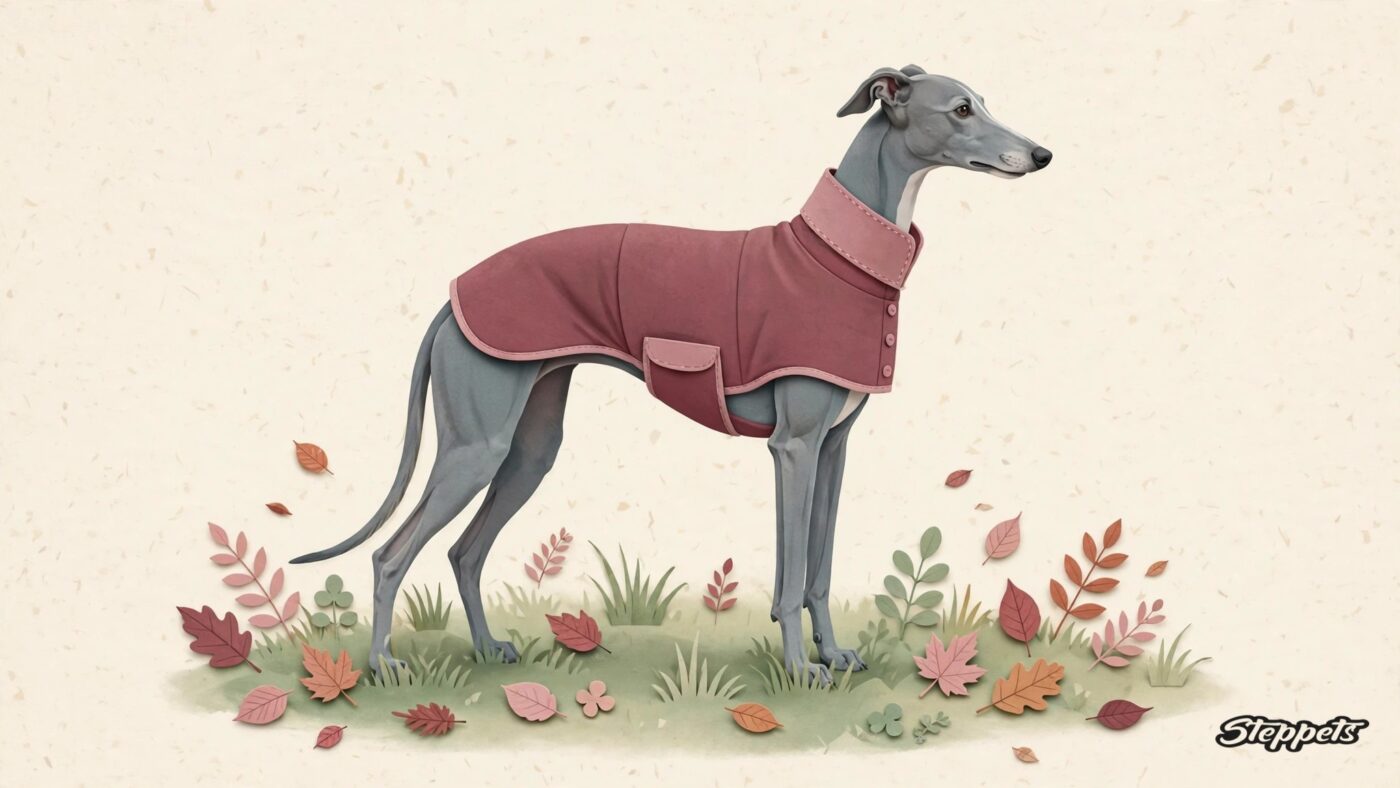
- Chest and back length fight each other. A Dachshund needs the back length of a much larger dog but the chest of a small one: size by length and the coat swims around the ribs; size by chest and half the back is uncovered. A Greyhound is the reverse — deep chest, narrow neck and waist — so a coat that closes over the chest hangs off the neck like a scarf.
The fix is not a better chart. It’s measuring the actual dog: five numbers precise enough for a pattern to be drafted to them — and to sanity-check any chart before you buy.
Which dog coat measurement matters most?
Chest circumference. It is the largest loop on the dog — around the ribcage at its widest point, just behind the front legs — and it is the number that decides whether a coat closes at all. If a dog’s chest falls outside a size’s range, that size is out, whatever the back length says.
What You Need
- A soft tailor’s tape measure — the flexible kind that drapes around curves. A metal builder’s tape will fight you and lie to you.
- Treats — small, quick ones. You’re paying for stillness, and stillness makes measurements honest.
- A helper, if you can get one — one person keeps the dog standing and feeds treats; the other measures. Solo is possible, just slower.
- A hard, flat floor — not a bed or grass. Posture changes measurements, and a dog sinking into a soft surface isn’t standing square.
- Somewhere to write the numbers down — phone notes or paper. Memory is not a measuring tool.
There’s also a modern alternative: the photo method. With PatternMade, our free measuring tool, you photograph your dog in profile with a credit card on the floor for scale, and it reads the same five measurements from the photo. More on that at the end — learn the tape method first if you can; understanding where numbers come from makes you better at checking them.
One rule governs everything below: measure a dog standing square — four feet planted, head up, weight even, looking ahead. Not sitting, curled, twisted or mid-sniff: posture is the invisible sixth measurement.
Measurement 1: Neck Circumference — 33 cm on Luna
Where exactly: around the neck where a collar naturally sits — the middle of the neck. At the front the tape crosses low on the throat; at the back, below the head and well above the shoulders. Think of the tape as a collar you’re fitting: the coat’s neck opening is drafted from this number.
How: wrap the tape at collar position, flat against the coat, snug, not tight. The test is the two-finger rule: two fingers should slide between tape and neck, but the tape shouldn’t slip over the shoulders or ride up over the jaw. Read the number and write it down before you let go.
The common mistake: measuring too low, where the neck flares into the shoulders. That flare adds centimetres the collar area doesn’t have — the most frequent neck error we see. Measuring up under the jaw reads small instead.
If it’s off: too big, and the neck opening slides and rotates, gaping at the front where wind and snow get in. Too small, and it presses on the throat — expect head-shaking, scratching, and a dog who won’t lower their head to sniff. A chart assuming Luna’s chest came with a 40 cm neck would hang off her 33 cm one.
Measurement 2: Neck Length — 13 cm on Luna
Where exactly: this is a length, not a loop — from the base of the neck, the junction where the neck’s rising outline meets the back line at the withers, up toward the ears, ending near the ear base. It’s the height a coat’s neck section (or a snood) needs to cover.
What is neck length on a dog?
Neck length is a straight length, not a loop: from the base of the neck — the junction where the neck’s rising outline meets the back line at the withers — up toward the ears, ending near the ear base. It starts at the same base point as back length; one landmark gives both numbers. On Luna it measures 13 cm.
How: find the base point first — run your hand down the back of the neck until the slope levels into the back. Rest the tape’s end there and run it up toward the ear base, head up in a natural position. Neck circumference and neck length share this base point — one landmark, two numbers.
The common mistake: measuring the whole visible neck from chest to skull, or measuring while the dog cranes down at a treat — a dipped neck reads long, a tucked one short. Head up, looking ahead, every time.
If it’s off: too short, and the neck section ends halfway up the neck, leaving the upper neck exposed and the garment creeping down as the dog moves. Too long, and fleece bunches behind the ears, pushes the coat backward, and can fold over the ears — which most dogs vote against with their whole body. Luna’s 13 cm marks a moderately-necked dog; a sighthound reads far more, a Bulldog far less.
Measurement 3: Chest Circumference — 56 cm on Luna
Where exactly: around the ribcage at its widest point, just behind the front legs — behind the elbows, around the barrel of the ribs, over the top of the back. This is the largest loop on the dog and the most important number in coat fitting: it decides whether the coat closes.
How: pass the tape under the chest just behind the front legs, bring it up so it sits vertically, not slanted, and pull it snug over the coat — fur compressed lightly, as a coat would sit. Not corset-tight: the dog still has to breathe and trot. Snug like a firm hug, then read it.
The common mistake: measuring too far forward, over the shoulders and front legs, which misses the ribcage’s true widest point — or in the soft tuck behind the ribs, which reads small. The other classic: measuring over a harness or sweater. Measure the dog.
If it’s off: too small, and the coat won’t close — or closes with the strap straining and the front-leg stride clipped for lack of ease where the legs swing. Too big, and the coat becomes a sail: swinging side to side, strap migrating, coverage everywhere except where you put it. Luna’s 56 cm breaks size charts for her — a “bigger dog” chest on a medium dog.
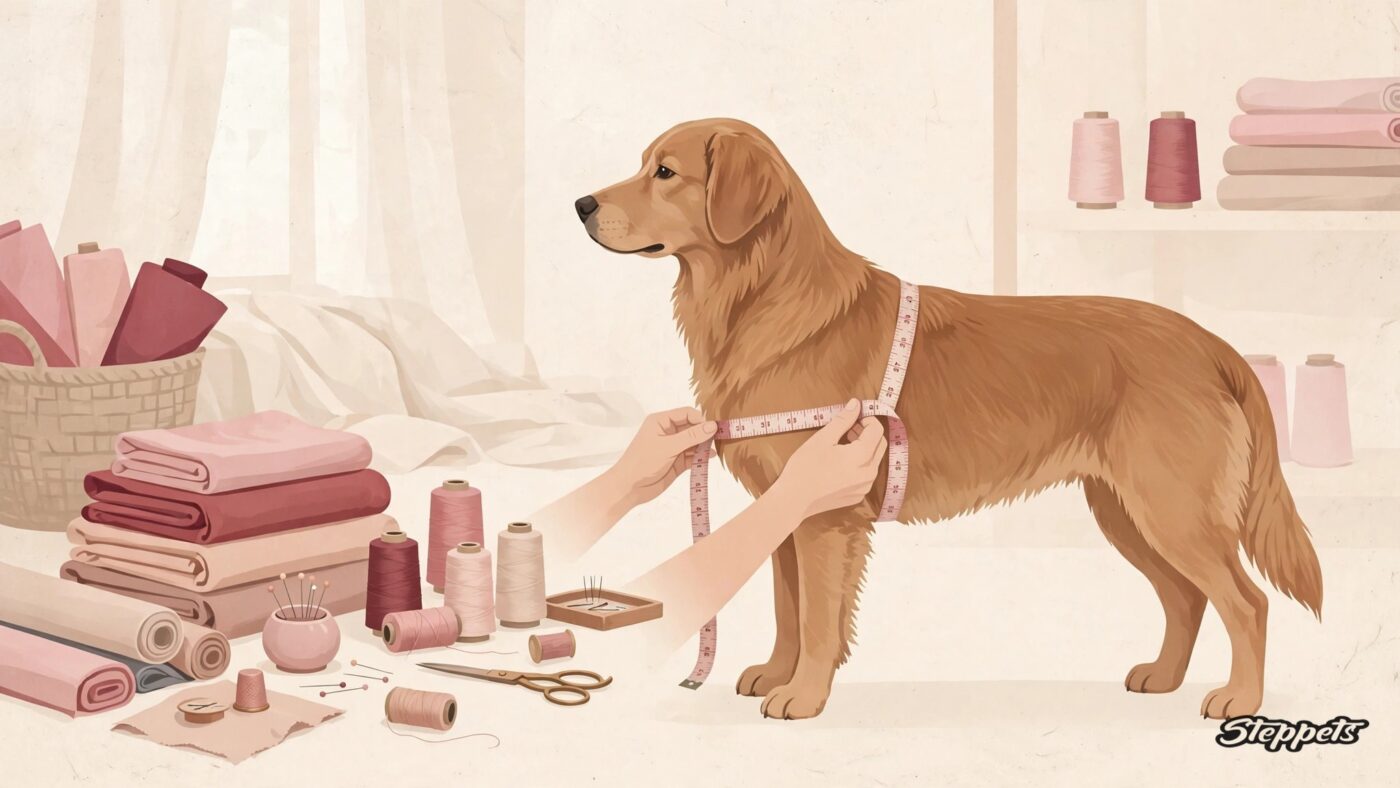
Measurement 4: Front Chest Width — 16 cm on Luna
Where exactly: the width across the front of the chest, from one shoulder tip to the other — the bony points at the front of each shoulder, which you can feel where the front leg meets the chest. The tape runs straight across the front between them.
How: stand in front of your dog (where the helper earns their treats). Find both points by feel first — don’t eyeball them through fur. Then hold the tape across the front, point to point, hugging the chest’s surface. A width, not a loop: never wrap it around the dog.
The common mistake: wrapping the tape around the chest and recording a second, smaller “circumference,” or measuring across the back between the shoulder blades. Through thick fur, the other error is measuring the fur’s outline rather than the points — press in gently until you feel bone on both sides.
If it’s off: this number shapes the coat’s front — neck-opening width and where the front leg area falls. Too narrow: pulling across the chest, leg openings dragged forward, rubbing at the armpits. Too wide: a gaping neck opening and enough slack for the coat to rotate. Luna’s 16 cm is a narrow, fine front — one reason chest circumference alone wouldn’t fit her.
Measurement 5: Back Length — 38 cm on Luna
Where exactly: from the base of the neck — the same neck-back point where neck length started, at the withers — along the topline to the base of the tail, the waist point just where the tail begins. Not from the collar, which sits partway up the neck, and not to the tip of the tail.
How: dog standing square, tape’s end at the base-of-neck point, run it along the top of the back following the topline to the tail base. Keep it on the back’s centre line; if the back dips or rises, follow the dog, not a ruler line through the air.
The common mistake: measuring from the collar — silently adding 5 cm or more of neck into a “back” number — or measuring a sitting, curled dog, which reads short. The sneaky version is treat placement: a dog stretching down to a treat at its feet isn’t standing square, and its topline isn’t at rest length.
If it’s off: too short, and the coat ends mid-back, leaving the hips and loins uncovered, with the chest strap landing too far forward. Too long, and fabric covers the tail base, fouls when the dog toilets, and slides like a blanket off a bed. Measured from the collar, Luna would read about 43 cm — a coat bought on that number would swamp her.
Where does back length start on a dog?
At the base of the neck, where the neck meets the back at the withers — not at the collar. The tape runs from that point along the topline to the base of the tail. The collar sits partway up the neck, so starting there silently adds 5 cm or more of neck into a number that is supposed to describe the back.
The Full Walkthrough, Start to Finish
Here is the whole routine, exactly as we’d do it with Luna:
- Set up. Hard floor, good light, treats ready, tape and phone in hand. Let the dog sniff the tape first — a boring tape is a safe one.
- Stand and settle. Lure your dog into standing square, head up, looking ahead at the helper (and the treat), weight even on all four feet. Ten quiet seconds here save ten re-measures.
- Measure in order. Neck circumference, neck length, chest circumference, front chest width, back length — this guide’s order, so you never guess which number you forgot.
- Write each number down immediately. All five, in centimetres. Luna’s card reads 33 / 13 / 56 / 16 / 38.
- Re-measure the odd one. If a number looks wrong for the dog in front of you — a chest reading smaller than the neck, a back length that moved 4 cm between reads — take it again. Two matching reads beat one confident guess; disagreement is usually posture.
Centimetres or Inches? Luna, Converted
We measure in centimetres because they’re finer-grained — no fraction arithmetic. But if your tape is in inches, or a chart demands them, convert once, at the end, from your written values. Luna’s five, converted (divide by 2.54):
- Neck circumference: 33 cm = 12.99 in
- Neck length: 13 cm = 5.12 in
- Chest circumference: 56 cm = 22.05 in
- Front chest width: 16 cm = 6.30 in
- Back length: 38 cm = 14.96 in
One warning: round for conversation, not for ordering. “About 15 inches” is fine at the dog park; the pattern wants 38 cm. Measuring in inches? Record the fractions honestly — fit lives in small numbers.
Troubleshooting: Real Dogs, Real Problems
The wriggly dog
Don’t wrestle — bribe and shorten. Measure after a walk, when the edge is off. Have the helper feed a slow stream of tiny treats, or smear something lickable on a mat in front of the dog; licking is stationary behaviour. One measurement per treat break if you must — a twisting dog gives invented numbers anyway.
The thick double coat
Measure over the fur, compressed lightly — press the tape in until you feel the body, at roughly the compression a garment would give it. Don’t measure the full fluffy outline, and don’t crush to skin-tight either. This is also why shoulder tips are found by feel: through a double coat, the outline lies in both directions.
Puppies
Puppy measurements have an expiry date. Young dogs grow in spurts and change proportions, not just size — legs first, then chest, then everything at once. Re-measure every few weeks while they’re growing, and always right before ordering anything fitted; the coat that fit at five months may be a crop top by eight.
The sleeping dog
Tempting, and wrong. A sleeping dog is a folded dog: spine flexed, neck tucked, chest compressed — every length reads short, and most dogs wake mid-measure and move suddenly anyway. Wait until they’re awake and standing.
Made-to-Measure vs. Off-the-Rack: How the Five Numbers Get Used
When a coat is made to measure, the five numbers stop being a shopping aid and become the pattern itself. On our Griffin coat, the neck section is drafted from neck circumference and neck length; the body from chest circumference and back length, strap placed from those proportions; and front chest width shapes the front so the neck opening sits where the chest actually is. Change any one number and the pattern changes — that’s the entire point.
Buying off-the-rack instead? The same five numbers become your lie detector for size charts:
- Compare all five, not just the one the chart leads with. If a chart lists only chest and length, treat the rest as unknown risk.
- Chest circumference decides closure. If your dog’s chest falls outside a size’s range, that size is out, whatever the length says — a coat that won’t close isn’t a coat.
- Then check back length. A centimetre or two short is a style choice; five centimetres short is an exposed lower back.
- Watch the conflict. If the chest says Medium and the back says Large, the dog isn’t built on that brand’s block. Sizing up buys length at the cost of a swimming chest — the exact dog made-to-measure exists for.
The Easier Way: Measure From a Photo
That’s the craft method, and it works. But some dogs won’t stand for a tape, and some owners don’t own one. That’s why we built PatternMade — free, right on our site. Photograph your dog standing in profile with a standard credit card on the floor for scale (or enter tape measurements instead), and it produces the same five numbers this guide teaches.
Those numbers feed straight into the Griffin configurator, where the coat is configured from your dog’s measurements and the pattern drafted to the dog you actually have. Photo or tape, the principle is identical: measure the dog, not the average. Still deciding whether your dog needs a coat at all? Start with our companion guide: How Cold Is Too Cold for a Dog?
Frequently Asked Questions
Where do I measure chest on a dog?
At the widest point of the ribcage, just behind the front legs — tape behind the elbows, around the barrel of the ribs, vertical and snug over lightly compressed fur. Not over the shoulders, not in the soft tuck behind the ribs.
How tight should the tape be?
Snug, not tight, for all five. On the neck, the two-finger rule. On the chest, a firm hug: fur lightly compressed, breathing free. Denting the dog is too tight; sliding on its own, too loose.
Can I use a string and a ruler?
Yes. Wrap non-stretch string (a shoelace or paper strip works) where the tape would go, mark where it meets, then measure it flat against a ruler.
How often should I re-measure a puppy?
Every few weeks during active growth, and always right before ordering anything fitted. Adults: once or twice a year, or after any real weight change — numbers drift more than owners expect.
What if my dog is between sizes?
Let chest circumference decide: pick the size whose chest range contains your dog’s chest, then check the back length isn’t drastically short. If chest and length point to different sizes, that’s a proportions mismatch — and the strongest argument for made-to-measure, where there are no sizes to be between.
Do I measure over or under the fur?
Over the fur, compressed lightly — never skin-tight, never the outer fluffy outline. A garment compresses the fur as it’s worn; your tape should do the same. Find bony landmarks by feel, through the fur.
Measure Once, Fit for Good
Five numbers. 33, 13, 56, 16, 38 — that’s Luna, completely described for coat purposes, in less space than a sentence. Your dog’s five are just as short and just as capable of ending the size-chart guessing game. Take them with a tape on a quiet afternoon, or from a photo in the next two minutes.
Ready when you are: measure your dog free with PatternMade, then see their coat take shape in the Griffin configurator — a coat drafted from your dog’s measurements, built for cold Quebec winters. Keep the numbers safe; refreshed now and then, they last for years of well-fitting coats.