The short answer: the pattern is built for a different dog
If you have ever put a “large” dog coat on a Greyhound and watched it slide, twist, choke, gap and rub in the same fitting, the problem is not your dog and it is not your measuring. Most coats sold as a greyhound dog coat are graded from a generic sporting-dog block: moderate chest, moderate waist, moderate neck, and a back length that roughly matches the chest size. A sighthound is almost the opposite brief. The chest is deep but narrow, the waist tucks up hard, the back is long, the neck is long, and there is very little insulation on the dog itself. When a standard pattern meets that geometry, every landmark lands in the wrong place.
The sighthound body, in fitter’s terms
A Greyhound, Whippet or Italian Greyhound is built for speed: a long spine, a deep chest that houses heart and lungs, and a waist drawn up hard underneath. The ribcage drops well below the elbow, then narrows quickly. That side profile is what breaks coat patterns.
The neck matters just as much. Sighthounds carry a long, fine neck with very little fat or loose skin. A coat neck that is merely “big enough” can still be wrong: too short, too round, or too tight for the dog to lower the head and sniff comfortably.
Then there is warmth. Sighthounds have a fine single coat and very little body fat compared with double-coated northern breeds. They are not fragile in spirit, but they lose heat quickly and they show cold honestly: tucked posture, shivering, reluctance to settle outdoors, and a sudden lack of interest in a walk they normally love.
The five classic fit failures
Most bad sighthound coats fail in predictable ways.
1. The chest strap lands on the tuck
On a typical dog, a belly or chest strap sits on a fairly level underside. On a Greyhound, the underside rises sharply behind the ribs. If the strap is placed where a standard pattern expects the belly to be, it lands on that upward tuck. Every step lets it creep backward, and the whole coat migrates toward the hips. Tightening does not help, because the anchor point itself is wrong.
Why does the strap on a Greyhound’s coat slide backwards?
Because of the tuck. A Greyhound’s underside rises sharply behind the ribs, so a chest strap placed where a standard pattern expects a level belly lands on that rising slope — and every step lets it creep backward, dragging the whole coat toward the hips. The fix is placement, not tightness: the strap belongs behind the chest’s widest point, where the body gives it something to hold.
2. The neck opening is sized for a Labrador
Many coats scale the neck hole with the chest size. That produces two bad options on a sighthound: a neck wide enough for the deep chest becomes a loose ring that drops and gaps, or a neck snug enough to stay up is too small for the dog to move the head comfortably. The sighthound neck is long rather than thick; it needs length and shape, not just circumference.
Why does a Greyhound coat need a long neck section?
A sighthound’s neck is long rather than thick, so the neck opening needs length and shape, not just a big enough circumference. A neck opening scaled to the breed’s deep chest becomes a loose ring that drops and gaps; one snug enough to stay up can stop the dog lowering its head to sniff. Long neck coverage also seals the throat and chest junction, where a fine-coated dog loses heat.
3. Back length right means chest coverage wrong
Size charts usually force a trade: choose by back length and the chest panel ends too high on the sternum; choose by chest and the coat stops halfway along the back. The deep chest needs coverage low and forward, while the long back needs length behind. A rectangular panel cannot do both, so a coat can look long enough standing still yet leave the deepest part of the chest exposed in motion.
4. The leg openings rub the deep chest
Front leg openings are often cut as simple circles placed for a shallower ribcage. On a sighthound, the foreleg sits close to a chest that drops and curves. If the opening is too far forward, too small, or finished with a stiff edge, it catches at the point of the shoulder and the soft skin behind the leg. Rubbing is a geometry problem, not a “wear it in” problem.
5. The coat twists because chest and waist are different countries
A coat stays straight when the body underneath gives it reasonably even support. A sighthound offers a wide, deep front and a much narrower tucked waist. Loose fabric over the ribs has room to rotate, while the narrow rear gives it little to hold onto — the familiar sideways saddle, with one side dropped and the strap angle changed.
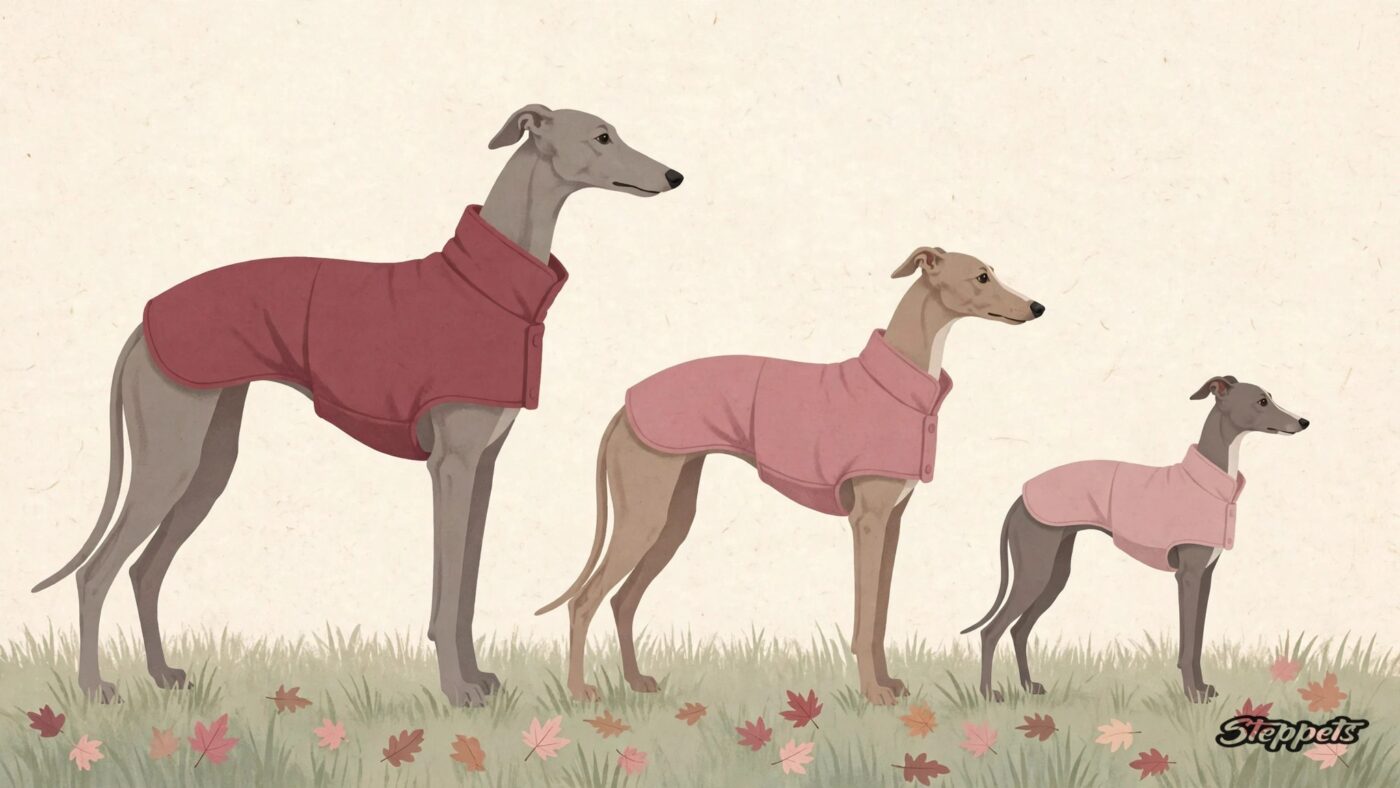
Whippets and Italian Greyhounds: same geometry, scaled
Whippets are not just small Greyhounds, but the fit logic is close: deep narrow chest, pronounced tuck, long neck, fine coat and a back that is longer than most size charts expect for the dog’s weight. Their common problem is in-between sizing. One size fits the chest and swamps the back; the next fits the back and makes the neck and strap placement wrong. When trying coats on a Whippet, prioritise strap position and chest coverage over a tidy size label.
Why are Whippets always between coat sizes?
Whippets share the Greyhound’s geometry — deep narrow chest, pronounced tuck, long neck, fine coat — at a smaller scale, and their proportions fall between standard size grades. One size fits the chest and swamps the back; the next fits the back and puts the neck opening and strap placement in the wrong place. When trying coats on a Whippet, judge strap position and chest coverage first and ignore the size label.
Italian Greyhounds scale the same shape down and add fragility. Their bones and skin are finer, their tolerance for pressure points is lower, and a strap or seam that a Greyhound would ignore can bother an Italian Greyhound quickly. Fit needs to be closer without being tight, with soft edges and no dependence on heavy hardware. For all three breeds, “scaled down” only works if the proportions are scaled too.
What a coat that fits a sighthound actually needs
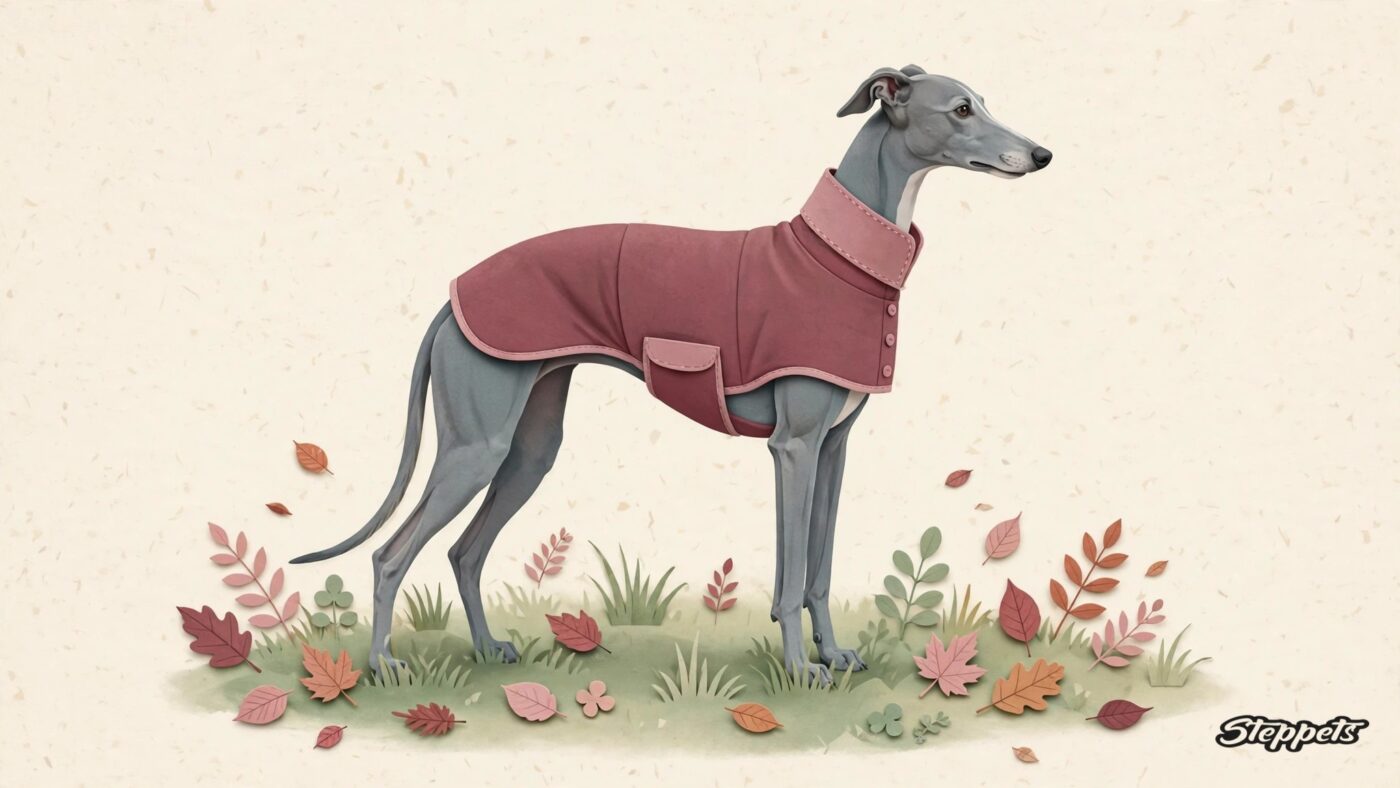
- Contoured chest coverage. The front should follow the sternum down and back, covering the deep ribcage instead of stopping at a straight line.
- Long neck coverage. The neck section should travel up the long neck and sit smoothly when the head is up, down or turned. Warmth at the throat and chest junction matters on a fine-coated dog.
- A strap placed behind the chest’s widest point. The anchor belongs where the body gives it something to hold, not on the rising tuck. Placement matters more than tightness.
- Room through the shoulder and elbow. Openings and seams should clear the foreleg through its full swing. At a walk and trot, the dog should be able to reach forward without the coat tugging the shoulder back.
- A body that resists rotation. Shaping through the ribcage, with less loose sail over the waist, helps the coat track straight instead of twisting toward the narrower rear.
- Freedom for the stride. Fit is judged at a walk and trot, but the stride underneath is the double-suspension gallop’s: long reach, folded tuck, full extension. Nothing should bind the hindquarters when the dog stretches out, turns, or shakes.
The test is dynamic. Stand the dog square, then walk, trot a few steps, turn both ways, let the dog lower the head and shake. The strap should stay in its county, the neck should neither strangle nor fall open, and the coat should move with the shoulder, not argue with it.
How do you check whether a Greyhound’s coat fits?
Test it moving, not standing. Walk and trot a few steps, turn both ways, and let the dog lower its head and shake. The strap should stay behind the chest’s widest point, the neck should neither strangle nor fall open, the forelegs should swing clear without rubbing, and the centre back should still be the centre back after the shake.
How to measure a sighthound for a coat
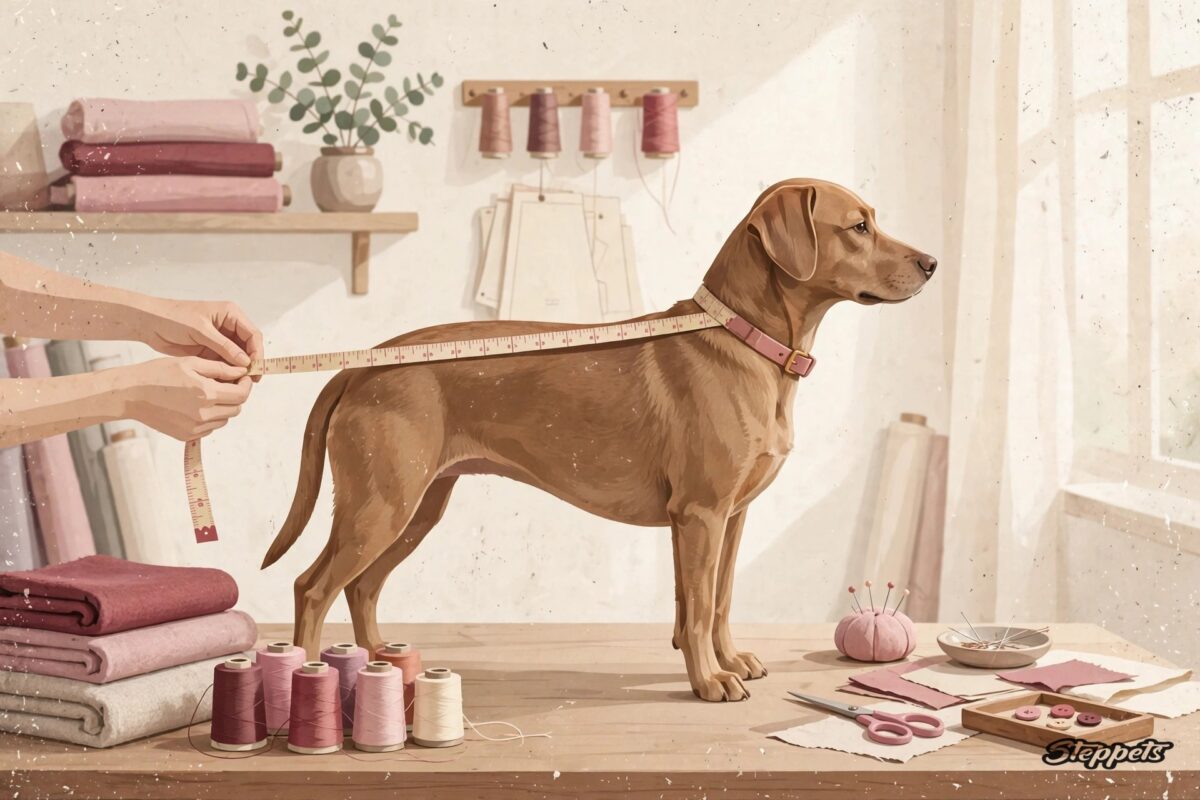
Measure the dog standing naturally on a flat surface, head in a normal position, with a soft tape — not sitting, and not just in from a run or the cold. For the full method, see our guide to how to measure a dog for a coat.
- Neck circumference: around the middle of the neck where coverage should sit, close but not tight. On a sighthound, do not substitute collar size without checking the position.
- Neck length: from the base of the neck at the shoulders up toward the head, following the top line the coat needs to cover.
- Chest circumference: around the widest, deepest part of the ribcage, usually just behind the forelegs, tape level and snug but not compressed.
- Front chest width: across the front of the chest, which helps separate a deep-but-narrow sighthound chest from a broad chest of the same girth.
- Back length: from the base of the neck to the point where the coat should end toward the tail, following the topline rather than cutting the corner underneath.
Write the numbers down before you shop. With sighthounds, the relationship between the numbers is the story: a long back beside a moderate neck and a deep chest is exactly the combination ready-made grading handles badly.
What measurements does a sighthound coat need?
Five, taken with a soft tape on a dog standing naturally: neck circumference, neck length, chest circumference, front chest width, and back length. The relationship between the numbers matters as much as the numbers themselves — a long back beside a moderate neck and a deep chest is exactly the combination ready-made size grading handles badly.
The made-to-measure answer
The cleanest fix is to stop asking a sighthound to fit a generic block. The Steppets Griffin is drafted from the dog’s own five measurements — neck circumference, neck length, chest circumference, front chest width and back length — so the neck section, chest coverage and strap position are placed for that individual body rather than averaged from a size run. It is built for cold Quebec winters, with a wool body and a fleece neck section, and the pattern work starts from the proportions that make sighthounds hard to fit in the first place. You can see the coat and start from your dog’s measurements on the Griffin custom dog coat page.
Made-to-measure does not remove the need to check fit when the coat arrives. It changes the starting point: the draft already knows the chest is deep, the waist is tucked and the neck is long.
Buying off the rack instead? Inspect these points
- Strap position on the dog, not on the hanger. Put it on and walk. If the strap sits on the rising tuck, it will travel.
- Chest coverage in profile. Look from the side. The deepest part of the ribcage should be covered, not left as the lowest exposed point.
- Neck behaviour. The dog should lower the head to sniff without the neck opening digging in or falling away.
- Leg clearance. Check behind the forelegs after several minutes of movement, not just standing. Early pinkness or displaced hair is a warning.
- Twist test. After a turn and a shake, is the centre back still the centre back?
- Size-chart honesty. If the brand gives only weight or only back length, expect guesswork; sighthounds need chest and neck numbers in the decision.
Frequently asked questions
Do Greyhounds really need coats?
Many do in cold, wet or windy weather. A fine single coat and very little body fat mean a Greyhound can lose heat quickly, especially standing around, walking slowly, or travelling in a cold car. A healthy dog on a brisk, dry walk may be comfortable without one; the dog’s posture, shivering and willingness to keep moving are better guides than pride or habit.
What temperature do Whippets need a coat?
As general care guidance, many Whippets start to appreciate a layer in single-digit Celsius temperatures, and sooner with wind, rain, age, illness, low body condition or a slow walk. There is no single number for every dog. Treat this as husbandry, not a rating for any garment: watch the individual dog and add or remove layers as conditions and pace change.
Why does my Greyhound’s coat slip sideways?
Usually because the chest is much broader and deeper than the tucked waist, so loose fabric rotates toward the narrower rear — or because the strap is anchored on the tuck and migrates. Tightening alone rarely fixes it; strap placement behind the chest’s widest point and closer shaping over the ribs address the cause.
How should a Greyhound coat fit?
It should cover the deep chest and a good length of neck, sit smoothly without squeezing the throat, keep its strap in place while walking and trotting, clear the forelegs through their swing, and stay centred after turns and a shake. The dog should be able to sniff the ground, toilet, and settle into a normal stride without the coat pulling it back.
Are Greyhound coats different from regular dog coats?
They should be. The differences are not cosmetic breed branding; they are pattern differences — chest contour, neck length and shape, strap placement, and the relationship between back length and ribcage depth. A regular coat can work by luck on an individual dog, but a sighthound-specific or made-to-measure pattern is designed around the geometry that causes the usual failures.
Start with the dog in front of you
A Greyhound is not a difficult dog to dress; it is a specific dog to dress. Measure the five numbers, respect the tuck, place the strap where the body can hold it, and the endless adjusting mostly disappears. For a coat drafted from those measurements rather than adapted from a generic size, start with the Griffin.